Find a Taylor series for f centered at 2 given that f⁽ᵏ⁾(2)=1, for all nonnegative integers k.
Table of contents
- 0. Functions7h 54m
- Introduction to Functions16m
- Piecewise Functions10m
- Properties of Functions9m
- Common Functions1h 8m
- Transformations5m
- Combining Functions27m
- Exponent rules32m
- Exponential Functions28m
- Logarithmic Functions24m
- Properties of Logarithms36m
- Exponential & Logarithmic Equations35m
- Introduction to Trigonometric Functions38m
- Graphs of Trigonometric Functions44m
- Trigonometric Identities47m
- Inverse Trigonometric Functions48m
- 1. Limits and Continuity2h 2m
- 2. Intro to Derivatives1h 33m
- 3. Techniques of Differentiation3h 18m
- 4. Applications of Derivatives2h 38m
- 5. Graphical Applications of Derivatives6h 2m
- 6. Derivatives of Inverse, Exponential, & Logarithmic Functions2h 37m
- 7. Antiderivatives & Indefinite Integrals1h 26m
- 8. Definite Integrals4h 44m
- 9. Graphical Applications of Integrals2h 27m
- 10. Physics Applications of Integrals 3h 16m
- 11. Integrals of Inverse, Exponential, & Logarithmic Functions2h 34m
- 12. Techniques of Integration7h 41m
- 13. Intro to Differential Equations2h 55m
- 14. Sequences & Series5h 36m
- 15. Power Series2h 19m
- 16. Parametric Equations & Polar Coordinates7h 58m
15. Power Series
Taylor Series & Taylor Polynomials
Problem 11.4.30
Textbook Question
Power series for derivatives
a. Differentiate the Taylor series centered at 0 for the following functions.
b. Identify the function represented by the differentiated series.
c. Give the interval of convergence of the power series for the derivative.
f(x) = (1 − x)⁻¹
Verified step by step guidance1
Start with the given function \( f(x) = (1 - x)^{-1} \). Recall that its Taylor series centered at 0 (Maclaurin series) is the geometric series \( \sum_{n=0}^{\infty} x^n \), valid for \( |x| < 1 \).
Differentiate the series term-by-term. The derivative of \( f(x) \) is \( f'(x) = \frac{d}{dx} (1 - x)^{-1} \). Using the power series, differentiate each term \( x^n \) to get \( n x^{n-1} \). So the differentiated series is \( \sum_{n=1}^{\infty} n x^{n-1} \).
Identify the function represented by the differentiated series. Differentiate \( f(x) = (1 - x)^{-1} \) directly using the chain rule: \( f'(x) = (1 - x)^{-2} \). This matches the sum of the differentiated series, confirming the function represented by the series.
Determine the interval of convergence for the differentiated series. Since the original series converges for \( |x| < 1 \), and differentiation does not change the radius of convergence, the interval remains \( (-1, 1) \).
Summarize: The differentiated power series is \( \sum_{n=1}^{\infty} n x^{n-1} \), representing the function \( (1 - x)^{-2} \), and it converges for \( |x| < 1 \).
Verified video answer for a similar problem:This video solution was recommended by our tutors as helpful for the problem above
Video duration:
2mPlay a video:
Was this helpful?
Key Concepts
Here are the essential concepts you must grasp in order to answer the question correctly.
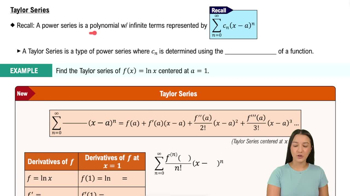
Taylor Series and Power Series
A Taylor series represents a function as an infinite sum of terms calculated from the function's derivatives at a single point, often zero (Maclaurin series). It expresses functions as power series, allowing approximation and analysis of functions using polynomials.
Recommended video:
Taylor Series
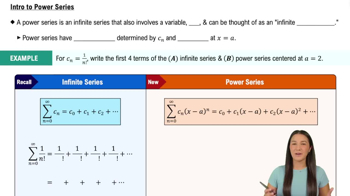
Term-by-Term Differentiation of Power Series
Power series can be differentiated term-by-term within their interval of convergence. Differentiating each term individually produces a new power series representing the derivative of the original function, preserving convergence properties inside the interval.
Recommended video:
Intro to Power Series
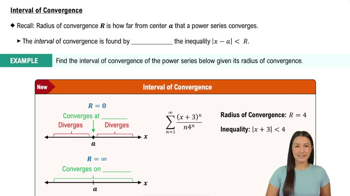
Interval of Convergence
The interval of convergence is the set of x-values for which a power series converges. Differentiating a power series does not change its radius of convergence, so the interval for the derivative series is the same or possibly smaller, requiring verification at endpoints.
Recommended video:
Interval of Convergence
Related Videos
Related Practice
Textbook Question
18
views