Estimate the open intervals on which the function y = Ζ(π) is
a. increasing. b. decreasing. c. Use the given graph of Ζ' to indicate where any local extreme values of the function occur, and whether each extreme is a relative maximum or minimum. <IMAGE>
Verified step by step guidance
1
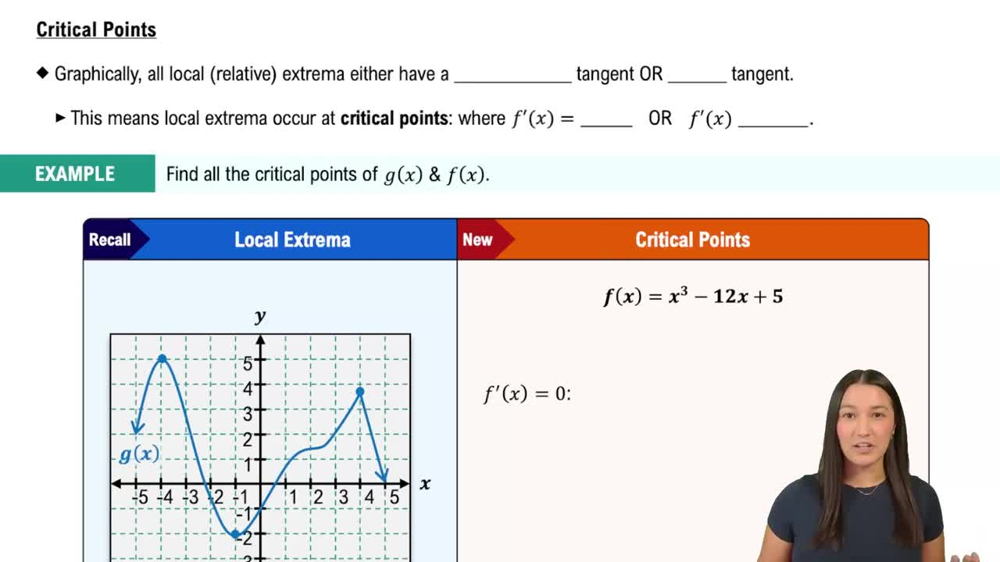
Identify the intervals where the derivative Ζ'(π) is positive. These intervals correspond to where the function y = Ζ(π) is increasing.
Identify the intervals where the derivative Ζ'(π) is negative. These intervals correspond to where the function y = Ζ(π) is decreasing.
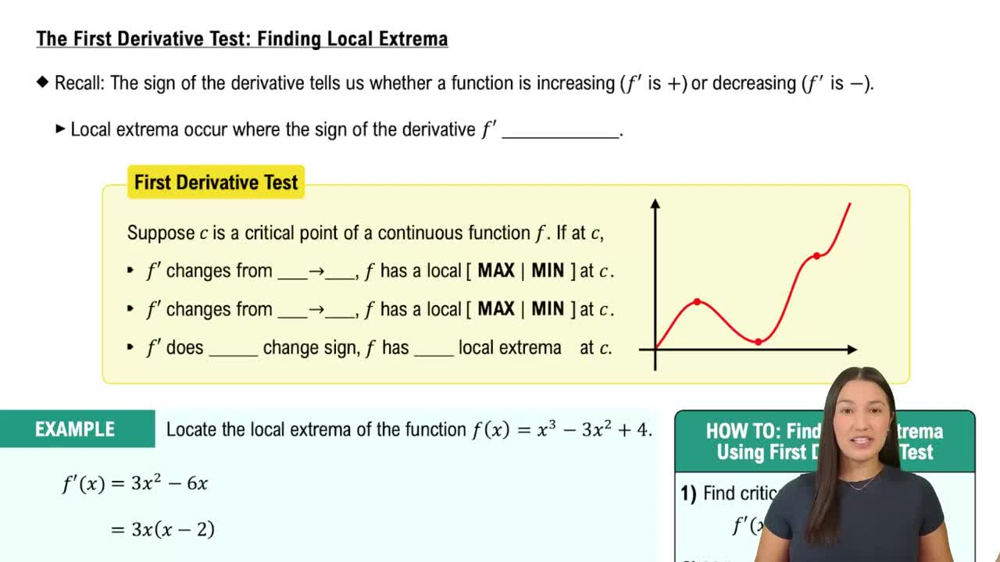
Locate the points where the derivative Ζ'(π) changes sign from positive to negative. These points are potential locations for relative maxima of the function y = Ζ(π).
Locate the points where the derivative Ζ'(π) changes sign from negative to positive. These points are potential locations for relative minima of the function y = Ζ(π).
Use the graph of Ζ'(π) to confirm the exact locations of these sign changes and determine the nature of each local extremum (maximum or minimum) based on the sign change.
Verified video answer for a similar problem:
This video solution was recommended by our tutors as helpful for the problem above
Video duration:
4m
Play a video:
0 Comments
Key Concepts
Here are the essential concepts you must grasp in order to answer the question correctly.
Derivative and its Sign
The derivative of a function, denoted as Ζ'(π), provides information about the rate of change of the function. If Ζ'(π) is positive over an interval, the function is increasing on that interval. Conversely, if Ζ'(π) is negative, the function is decreasing. Understanding the sign of the derivative is crucial for determining where the function is increasing or decreasing.
Critical points occur where the derivative Ζ'(π) is zero or undefined. These points are potential locations for local extreme values, such as relative maxima or minima. Analyzing the behavior of the derivative around these points helps identify whether they correspond to peaks (maxima) or troughs (minima) in the function.
The First Derivative Test is used to classify critical points as relative maxima or minima. By examining the sign change of Ζ'(π) around a critical point, one can determine the nature of the extremum. If Ζ'(π) changes from positive to negative, the point is a relative maximum; if it changes from negative to positive, it is a relative minimum.