
Shallow-water velocity equation a. Confirm that the linear approximation to ƒ(x) = tanh x at a = 0 is L(x) = x.
Verified step by step guidance
1
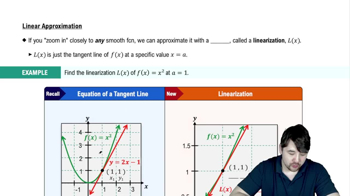
Recall that the linear approximation (or linearization) of a function \( f(x) \) at a point \( a \) is given by the formula:
\[ L(x) = f(a) + f'(a)(x - a) \]
Identify the function and the point of approximation: here, \( f(x) = \tanh x \) and \( a = 0 \).
Calculate \( f(a) = \tanh 0 \). Since \( \tanh 0 = 0 \), this simplifies the linear approximation formula.
Find the derivative of \( f(x) = \tanh x \). Recall that \( \frac{d}{dx} \tanh x = \operatorname{sech}^2 x \).
Evaluate the derivative at \( a = 0 \): \( f'(0) = \operatorname{sech}^2 0 \). Since \( \operatorname{sech} 0 = 1 \), this gives \( f'(0) = 1 \). Substitute these values into the linear approximation formula to get \( L(x) = 0 + 1 \cdot (x - 0) = x \).
Verified video answer for a similar problem:
This video solution was recommended by our tutors as helpful for the problem above
Video duration:
2m
Play a video:
Was this helpful?
Key Concepts
Here are the essential concepts you must grasp in order to answer the question correctly.
Linear Approximation (Linearization)
Linear approximation involves approximating a function near a point using the tangent line at that point. It is given by L(x) = f(a) + f'(a)(x - a), which simplifies calculations by replacing complex functions with linear ones close to a. This method is useful for estimating function values near the point a.
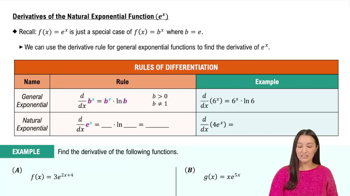
The derivative of tanh(x) is sech²(x), which measures the rate of change of tanh(x) at any point x. Evaluating this derivative at a specific point, such as x = 0, is essential for finding the slope of the tangent line used in linear approximation.
Derivative of the Natural Exponential Function (e^x)
Properties of tanh(x) at x = 0
At x = 0, tanh(0) = 0, and its derivative f'(0) = sech²(0) = 1. These values simplify the linear approximation formula to L(x) = 0 + 1*(x - 0) = x, confirming that near zero, tanh(x) behaves approximately like the identity function.