
Ch. 3 - Derivatives
Hass - Thomas' Calculus 15th Edition
Hass15th EditionThomas' CalculusISBN: 9780137616077Not the one you use?Change textbook
Chapter 3, Problem 3.2.34b

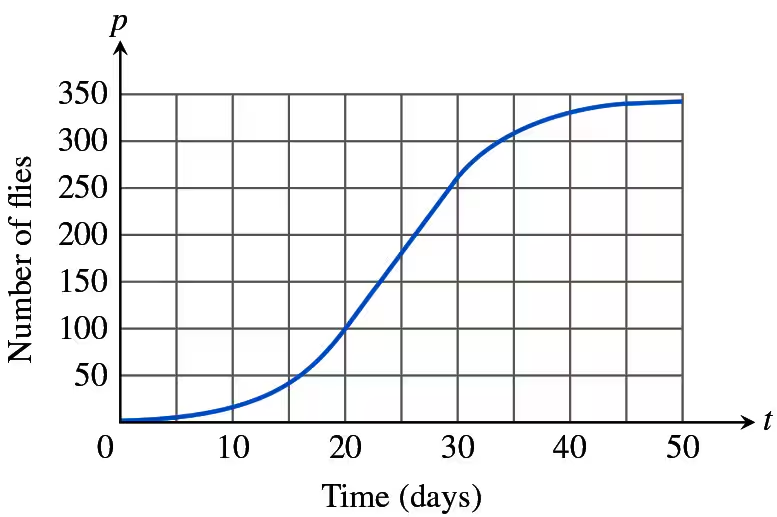
Fruit flies (Continuation of Example 4, Section 2.1.) Populations starting out in closed environments grow slowly at first, when there are relatively few members, then more rapidly as the number of reproducing individuals increases and resources are still abundant, then slowly again as the population reaches the carrying capacity of the environment.


b. During what days does the population seem to be increasing fastest? Slowest?


Graph showing the population of fruit flies over time, illustrating growth phases and carrying capacity.

Verified step by step guidance
1
Observe the graph of the population of fruit flies over time. The graph shows a typical logistic growth curve, which starts slow, increases rapidly, and then slows down as it approaches the carrying capacity.
Identify the steepest part of the curve, which indicates the period of fastest growth. This is where the slope of the curve is the greatest. On the graph, this appears to be between days 10 and 30.
Determine the period of slowest growth by looking at the flatter sections of the curve. Initially, from day 0 to around day 10, the growth is slow as the population is small. Similarly, after day 30, the growth slows down again as the population approaches the carrying capacity.
Understand that the rate of change of the population can be analyzed by considering the derivative of the population function with respect to time. The derivative gives the rate of growth, and its maximum value corresponds to the fastest growth period.
Conclude that the fastest growth occurs during the steepest part of the curve, and the slowest growth occurs during the flatter sections at the beginning and end of the graph.

Verified video answer for a similar problem:

This video solution was recommended by our tutors as helpful for the problem above.
Video duration:
5m
Was this helpful?

Key Concepts

Here are the essential concepts you must grasp in order to answer the question correctly.

Population Growth Phases

Population growth typically follows three phases: lag, exponential, and stationary. In the lag phase, growth is slow due to a small number of individuals. The exponential phase sees rapid growth as resources are abundant and reproduction increases. Finally, the stationary phase occurs when the population reaches the carrying capacity of the environment, leading to a slowdown in growth.
Recommended video:
09:29
Exponential Growth & Decay

Carrying Capacity

Carrying capacity refers to the maximum population size that an environment can sustain indefinitely without degrading the habitat. It is influenced by factors such as food availability, space, and environmental conditions. In the context of the fruit fly population, the carrying capacity is evident when the growth rate slows as the population approaches a stable number.
Recommended video:
07:39
Intro to the Chain Rule Example 2

Rate of Change

The rate of change in a population can be analyzed using calculus, particularly through the concept of derivatives. The derivative of the population function with respect to time indicates how fast the population is increasing or decreasing. By examining the graph, one can identify intervals where the population is increasing fastest (steepest slope) and slowest (flattest slope).
Recommended video:
04:16
Intro To Related Rates