Ch. 3 - Derivatives
Hass - Thomas' Calculus 15th Edition
Hass15th EditionThomas' CalculusISBN: 9780137616077Not the one you use?Change textbook
Chapter 3, Problem 3.3.35b

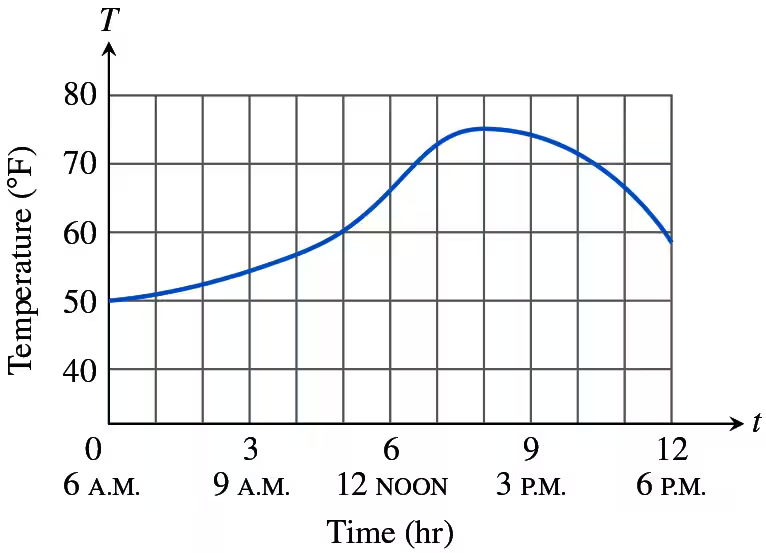
Temperature The given graph shows the outside temperature T in °F, between 6 a.m. and 6 p.m.
ddd
b. At what time does the temperature increase most rapidly? Decrease most rapidly? What is the rate for each of those times?

Verified step by step guidance
1
To determine when the temperature increases most rapidly, we need to find the point on the graph where the slope of the tangent line is the steepest in the positive direction. This corresponds to the maximum value of the derivative of the temperature function T(t) with respect to time t.
Observe the graph and identify the section where the curve is steepest in the upward direction. This typically occurs before the peak of the graph, where the temperature is rising quickly.
To determine when the temperature decreases most rapidly, look for the point where the slope of the tangent line is the steepest in the negative direction. This corresponds to the minimum value of the derivative of the temperature function T(t) with respect to time t.
Observe the graph and identify the section where the curve is steepest in the downward direction. This typically occurs after the peak of the graph, where the temperature is falling quickly.
The rate of change of temperature at these times can be estimated by calculating the slope of the tangent line at these points. The slope is the change in temperature divided by the change in time, which can be approximated by the rise over run on the graph.

Verified video answer for a similar problem:

This video solution was recommended by our tutors as helpful for the problem above.
Video duration:
5m
Was this helpful?

Key Concepts

Here are the essential concepts you must grasp in order to answer the question correctly.

Rate of Change

The rate of change refers to how a quantity changes over time, often represented mathematically as the derivative of a function. In the context of the temperature graph, it indicates how quickly the temperature is increasing or decreasing at any given moment. A higher rate of change signifies a steeper slope on the graph, which corresponds to a rapid increase or decrease in temperature.
Recommended video:
04:16
Intro To Related Rates

Critical Points

Critical points are values in the domain of a function where the derivative is either zero or undefined. These points are essential for identifying local maxima and minima, which in this case would indicate the times when the temperature reaches its highest or lowest values. Analyzing critical points helps determine when the temperature increases or decreases most rapidly.
Recommended video:
04:50
Critical Points

Inflection Points

Inflection points are points on a curve where the concavity changes, indicating a shift in the rate of increase or decrease of the function. In the temperature graph, inflection points can help identify transitions between increasing and decreasing temperature trends. Recognizing these points is crucial for understanding the overall behavior of the temperature throughout the day.
Recommended video:
04:50
Critical Points