
Ch. 4 - Applications of Derivatives
Hass - Thomas' Calculus 15th Edition
Hass15th EditionThomas' CalculusISBN: 9780137616077Not the one you use?Change textbook
Chapter 4, Problem 4.5.26

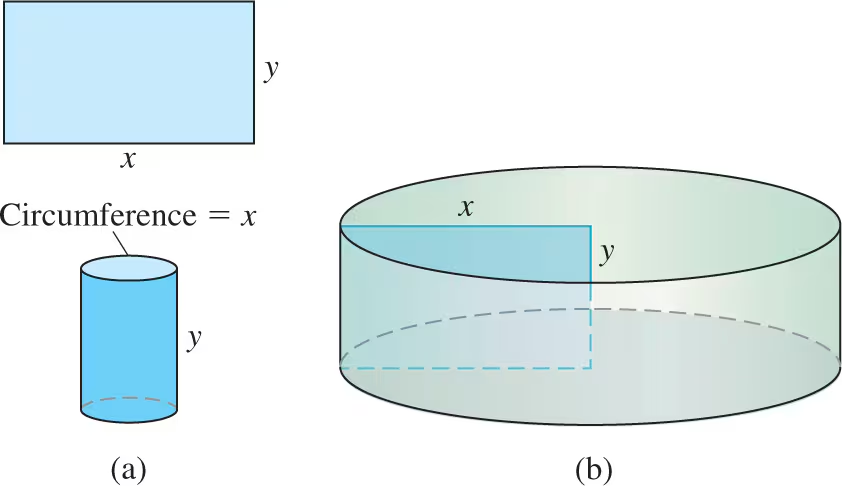
26. Constructing cylinders Compare the answers to the following two construction problems.
a. A rectangular sheet of perimeter 36 cm and dimensions x cm by y cm is to be rolled into a cylinder as shown in part (a) of the figure. What values of x and y give the largest volume?
b. The same sheet is to be revolved about one of the sides of length y to sweep out the cylinder as shown in part (b) of the figure. What values of x and y give the largest volume?
<IMAGE>

Verified step by step guidance
1
Step 1: Define the problem mathematically. For part (a), the rectangular sheet is rolled into a cylinder where the circumference of the base is x and the height is y. For part (b), the sheet is revolved about the side of length y, forming a cylinder with height y and radius x/2.
Step 2: Express the perimeter constraint. The perimeter of the rectangular sheet is given as 36 cm, so we have the equation: 2x + 2y = 36. Simplify this to y = 18 - x.
Step 3: Write the volume formulas. For part (a), the volume of the cylinder is V = πr²h, where r = x/(2π) (radius derived from circumference x) and h = y. Substitute y = 18 - x into the formula. For part (b), the volume is V = πr²h, where r = x/2 and h = y. Again, substitute y = 18 - x into the formula.
Step 4: Maximize the volume. For both parts, take the derivative of the respective volume functions with respect to x, set the derivative equal to zero, and solve for x. Use the constraint y = 18 - x to find the corresponding value of y.
Step 5: Verify the solution. Check the second derivative to ensure the critical points correspond to a maximum. Compare the maximum volumes obtained for part (a) and part (b) to complete the analysis.

Verified video answer for a similar problem:

This video solution was recommended by our tutors as helpful for the problem above.
Video duration:
7m
Was this helpful?

Key Concepts

Here are the essential concepts you must grasp in order to answer the question correctly.

Volume of a Cylinder

The volume of a cylinder is calculated using the formula V = πr²h, where r is the radius of the base and h is the height. In this problem, the dimensions of the rectangular sheet (x and y) will determine the radius and height of the resulting cylinder. Understanding how to derive these dimensions from the given perimeter is crucial for maximizing the volume.
Recommended video:
04:48
Finding Volume Using Disks

Optimization in Calculus

Optimization involves finding the maximum or minimum values of a function. In this context, we need to maximize the volume of the cylinder formed from the rectangular sheet. This typically requires setting up a function based on the dimensions and using techniques such as taking derivatives and applying critical point analysis to find optimal values.
Recommended video:
10:13
Intro to Applied Optimization: Maximizing Area

Perimeter Constraints

The perimeter of the rectangular sheet is a constraint that affects the dimensions x and y. Given that the perimeter is 36 cm, we have the equation 2x + 2y = 36, which simplifies to x + y = 18. This relationship must be used to express one variable in terms of the other when setting up the volume function for optimization.
Recommended video:
10:13
Intro to Applied Optimization: Maximizing Area
Related Practice
Textbook Question

Identifying Extrema


In Exercises 15–18:


a. Find the open intervals on which the function is increasing and those on which it is decreasing.


b. Identify the function’s local and absolute extreme values, if any, saying where they occur.


206
views
Textbook Question

107. Marginal cost The accompanying graph shows the hypothetical cost c=f(x) of manufacturing x items. At approximately what production level does the marginal cost change from decreasing to increasing?

134
views
Textbook Question

Theory and Examples


In Exercises 53 and 54, show that the function has neither an absolute minimum nor an absolute maximum on its natural domain.


y = x¹¹ + x³ + x − 5

206
views
Textbook Question

Motion with constant acceleration The standard equation for the position s of a body moving with a constant acceleration a along a coordinate line is s = (a/2)t² + v₀t + s₀, where v₀ and s₀ are the body’s velocity and position at time t = 0. Derive this equation by solving the initial value problem

Differential equation: d²s/dt² = a

Initial conditions: ds/dt = v₀ and s = s₀ when t=0.

52
views
Textbook Question

Checking the Mean Value Theorem


Find the value or values of c that satisfy the equation (f(b) − f(a)) / (b − a) = f′(c) in the conclusion of the Mean Value Theorem for the functions and intervals in Exercises 1–6.


f(x) =√(x − 1), [1, 3]

259
views
Textbook Question

Applications


A marathoner ran the 26.2-mi New York City Marathon in 2.2 hours. Show that at least twice the marathoner was running at exactly 11 mph, assuming the initial and final speeds are zero.

213
views