

25–30. Converting coordinates Express the following polar coordinates in Cartesian coordinates.
(1, 2π/3)
Verified step by step guidance
1
Recall the formulas to convert polar coordinates \((r, \theta)\) to Cartesian coordinates \((x, y)\):
\(x = r \cos(\theta)\)
\(y = r \sin(\theta)\)
Identify the given polar coordinates:
\(r = 1\)
\(\theta = \frac{2\pi}{3}\)
Substitute the values into the formulas:
\(x = 1 \times \cos\left(\frac{2\pi}{3}\right)\)
\(y = 1 \times \sin\left(\frac{2\pi}{3}\right)\)
Evaluate the trigonometric functions \(\cos\left(\frac{2\pi}{3}\right)\) and \(\sin\left(\frac{2\pi}{3}\right)\) using the unit circle or known values.
Write the Cartesian coordinates as the ordered pair \((x, y)\) using the evaluated values from the previous step.
Verified video answer for a similar problem:
This video solution was recommended by our tutors as helpful for the problem above
Video duration:
1m
Play a video:
0 Comments
Key Concepts
Here are the essential concepts you must grasp in order to answer the question correctly.
Polar Coordinates
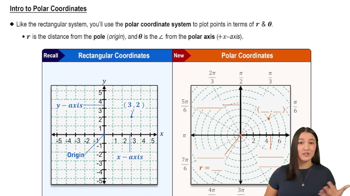
Polar coordinates represent a point in the plane using a radius and an angle, denoted as (r, θ), where r is the distance from the origin and θ is the angle measured from the positive x-axis. This system is useful for describing points in circular or rotational contexts.
Conversion Formulas from Polar to Cartesian Coordinates
To convert polar coordinates (r, θ) to Cartesian coordinates (x, y), use the formulas x = r cos(θ) and y = r sin(θ). These formulas translate the radius and angle into horizontal and vertical distances on the Cartesian plane.
Understanding sine and cosine functions is essential for conversion, as they relate angles to ratios of sides in right triangles. Angles in radians, like 2π/3, must be interpreted correctly to find accurate x and y values.