Which of the following transformations results in a vertical stretch of the exponential decay function ?
Table of contents
- 0. Functions7h 54m
- Introduction to Functions16m
- Piecewise Functions10m
- Properties of Functions9m
- Common Functions1h 8m
- Transformations5m
- Combining Functions27m
- Exponent rules32m
- Exponential Functions28m
- Logarithmic Functions24m
- Properties of Logarithms36m
- Exponential & Logarithmic Equations35m
- Introduction to Trigonometric Functions38m
- Graphs of Trigonometric Functions44m
- Trigonometric Identities47m
- Inverse Trigonometric Functions48m
- 1. Limits and Continuity2h 2m
- 2. Intro to Derivatives1h 33m
- 3. Techniques of Differentiation3h 18m
- 4. Applications of Derivatives2h 38m
- 5. Graphical Applications of Derivatives6h 2m
- 6. Derivatives of Inverse, Exponential, & Logarithmic Functions2h 37m
- 7. Antiderivatives & Indefinite Integrals1h 26m
- 8. Definite Integrals4h 44m
- 9. Graphical Applications of Integrals2h 27m
- 10. Physics Applications of Integrals 3h 16m
- 11. Integrals of Inverse, Exponential, & Logarithmic Functions2h 34m
- 12. Techniques of Integration7h 41m
- 13. Intro to Differential Equations2h 55m
- 14. Sequences & Series5h 36m
- 15. Power Series2h 19m
- 16. Parametric Equations & Polar Coordinates7h 58m
0. Functions
Exponential Functions
Problem 7.2.54
Textbook Question
Geometric means A quantity grows exponentially according to y(t) = y₀eᵏᵗ. What is the relationship among m, n, and p such that y(p) = √(y(m)y(n))?
Verified step by step guidance1
Start with the given exponential growth function: \(y(t) = y_0 e^{k t}\), where \(y_0\) and \(k\) are constants.
Write the expressions for \(y(m)\), \(y(n)\), and \(y(p)\) using the function: \(y(m) = y_0 e^{k m}\), \(y(n) = y_0 e^{k n}\), and \(y(p) = y_0 e^{k p}\).
Set up the equation given by the problem: \(y(p) = \sqrt{y(m) y(n)}\).
Substitute the expressions for \(y(m)\), \(y(n)\), and \(y(p)\) into the equation: \(y_0 e^{k p} = \sqrt{(y_0 e^{k m})(y_0 e^{k n})}\).
Simplify the right side by multiplying inside the square root and then taking the square root, and then solve for the relationship among \(m\), \(n\), and \(p\) by equating the exponents.
Verified video answer for a similar problem:This video solution was recommended by our tutors as helpful for the problem above
Video duration:
4mPlay a video:
Was this helpful?
Key Concepts
Here are the essential concepts you must grasp in order to answer the question correctly.
Exponential Growth Function
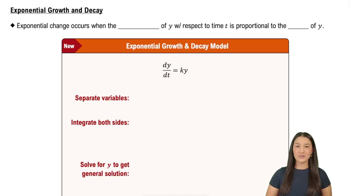
An exponential growth function is expressed as y(t) = y₀e^{kt}, where y₀ is the initial value, k is the growth rate, and t is time. The function models quantities that increase proportionally to their current value, leading to rapid growth over time.
Recommended video:
Exponential Growth & Decay
Geometric Mean
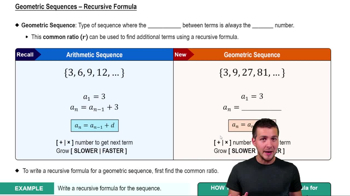
The geometric mean of two positive numbers a and b is √(ab). It represents the central tendency by multiplying the numbers and taking the square root, often used to find a value that balances exponential relationships between quantities.
Recommended video:
Guided course
Geometric Sequences - Recursive Formula
Properties of Exponents and Logarithms
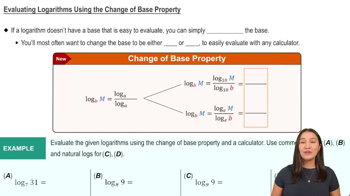
Exponential expressions like e^{kt} follow rules such as e^{a} * e^{b} = e^{a+b}. Taking logarithms can simplify equations involving exponentials, allowing us to solve for variables by converting multiplicative relationships into additive ones.
Recommended video:
Change of Base Property
Watch next
Master Exponential Functions with a bite sized video explanation from Patrick
Start learningRelated Videos
Related Practice
Multiple Choice
27
views