Which operation can be used to eliminate the natural logarithm () from both sides of an equation such as ?
Table of contents
- 0. Functions7h 54m
- Introduction to Functions16m
- Piecewise Functions10m
- Properties of Functions9m
- Common Functions1h 8m
- Transformations5m
- Combining Functions27m
- Exponent rules32m
- Exponential Functions28m
- Logarithmic Functions24m
- Properties of Logarithms36m
- Exponential & Logarithmic Equations35m
- Introduction to Trigonometric Functions38m
- Graphs of Trigonometric Functions44m
- Trigonometric Identities47m
- Inverse Trigonometric Functions48m
- 1. Limits and Continuity2h 2m
- 2. Intro to Derivatives1h 33m
- 3. Techniques of Differentiation3h 18m
- 4. Applications of Derivatives2h 38m
- 5. Graphical Applications of Derivatives6h 2m
- 6. Derivatives of Inverse, Exponential, & Logarithmic Functions2h 37m
- 7. Antiderivatives & Indefinite Integrals1h 26m
- 8. Definite Integrals4h 44m
- 9. Graphical Applications of Integrals2h 27m
- 10. Physics Applications of Integrals 3h 16m
- 11. Integrals of Inverse, Exponential, & Logarithmic Functions2h 34m
- 12. Techniques of Integration7h 41m
- 13. Intro to Differential Equations2h 55m
- 14. Sequences & Series5h 36m
- 15. Power Series2h 19m
- 16. Parametric Equations & Polar Coordinates7h 58m
0. Functions
Exponential Functions
Problem 7.2.33
Textbook Question
Atmospheric pressure The pressure of Earth’s atmosphere at sea level is approximately 1000 millibars and decreases exponentially with elevation. At an elevation of 30,000 ft (approximately the altitude of Mt. Everest), the pressure is one-third the sea-level pressure. At what elevation is the pressure half the sea-level pressure? At what elevation is it 1% of the sea-level pressure?
Verified step by step guidance1
Identify the given information: the atmospheric pressure at sea level is \(P_0 = 1000\) millibars, and the pressure decreases exponentially with elevation \(h\). This means the pressure \(P(h)\) can be modeled as \(P(h) = P_0 e^{kh}\), where \(k\) is a constant to be determined and \(h\) is the elevation in feet.
Use the information at 30,000 ft to find the constant \(k\). At \(h = 30000\), the pressure is one-third of sea-level pressure, so \(P(30000) = \frac{1}{3} P_0\). Substitute into the model: \(\frac{1}{3} P_0 = P_0 e^{k \times 30000}\). Simplify to get \(\frac{1}{3} = e^{30000k}\).
Solve for \(k\) by taking the natural logarithm of both sides: \(\ln\left(\frac{1}{3}\right) = 30000k\), which gives \(k = \frac{\ln\left(\frac{1}{3}\right)}{30000}\).
Find the elevation \(h_{1/2}\) where the pressure is half the sea-level pressure: \(P(h_{1/2}) = \frac{1}{2} P_0\). Substitute into the model: \(\frac{1}{2} P_0 = P_0 e^{k h_{1/2}}\), which simplifies to \(\frac{1}{2} = e^{k h_{1/2}}\). Take the natural logarithm to solve for \(h_{1/2}\): \(\ln\left(\frac{1}{2}\right) = k h_{1/2}\), so \(h_{1/2} = \frac{\ln\left(\frac{1}{2}\right)}{k}\).
Similarly, find the elevation \(h_{0.01}\) where the pressure is 1% of sea-level pressure: \(P(h_{0.01}) = 0.01 P_0\). Substitute into the model: \$0.01 = e^{k h_{0.01}}\(. Take the natural logarithm: \)\ln(0.01) = k h_{0.01}\(, so \)h_{0.01} = \frac{\ln(0.01)}{k}$.
Verified video answer for a similar problem:This video solution was recommended by our tutors as helpful for the problem above
Video duration:
4mPlay a video:
Was this helpful?
Key Concepts
Here are the essential concepts you must grasp in order to answer the question correctly.
Exponential Decay
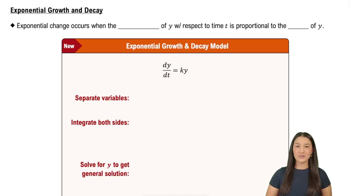
Exponential decay describes processes where a quantity decreases at a rate proportional to its current value. In this problem, atmospheric pressure decreases exponentially with elevation, meaning pressure drops rapidly at first and then more slowly as altitude increases.
Recommended video:
Exponential Growth & Decay
Pressure as a Function of Elevation
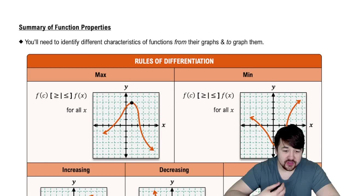
Atmospheric pressure at a given elevation can be modeled as P(h) = P0 * e^(-kh), where P0 is sea-level pressure, h is elevation, and k is a positive constant. Understanding this relationship allows calculation of pressure at any height by applying the exponential decay formula.
Recommended video:
Properties of Functions
Solving for Variables in Exponential Equations
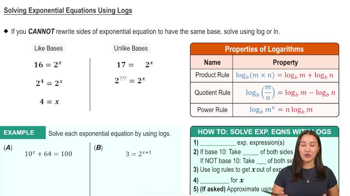
To find the elevation corresponding to a specific pressure, one must solve exponential equations by isolating the variable in the exponent. This typically involves taking natural logarithms to linearize the equation and then solving for the elevation.
Recommended video:
Solving Exponential Equations Using Logs
Watch next
Master Exponential Functions with a bite sized video explanation from Patrick
Start learningRelated Videos
Related Practice
Multiple Choice
60
views