Which of the following best describes the function ?
Table of contents
- 0. Functions7h 54m
- Introduction to Functions16m
- Piecewise Functions10m
- Properties of Functions9m
- Common Functions1h 8m
- Transformations5m
- Combining Functions27m
- Exponent rules32m
- Exponential Functions28m
- Logarithmic Functions24m
- Properties of Logarithms36m
- Exponential & Logarithmic Equations35m
- Introduction to Trigonometric Functions38m
- Graphs of Trigonometric Functions44m
- Trigonometric Identities47m
- Inverse Trigonometric Functions48m
- 1. Limits and Continuity2h 2m
- 2. Intro to Derivatives1h 33m
- 3. Techniques of Differentiation3h 18m
- 4. Applications of Derivatives2h 38m
- 5. Graphical Applications of Derivatives6h 2m
- 6. Derivatives of Inverse, Exponential, & Logarithmic Functions2h 37m
- 7. Antiderivatives & Indefinite Integrals1h 26m
- 8. Definite Integrals4h 44m
- 9. Graphical Applications of Integrals2h 27m
- 10. Physics Applications of Integrals 3h 16m
- 11. Integrals of Inverse, Exponential, & Logarithmic Functions2h 34m
- 12. Techniques of Integration7h 41m
- 13. Intro to Differential Equations2h 55m
- 14. Sequences & Series5h 36m
- 15. Power Series2h 19m
- 16. Parametric Equations & Polar Coordinates7h 58m
0. Functions
Exponential Functions
Problem 7.2.7
Textbook Question
Suppose a quantity described by the function y(t) = y₀eᵏᵗ, where t is measured in years, has a doubling time of 20 years. Find the rate constant k.
Verified step by step guidance1
Identify the given function: \(y(t) = y_0 e^{k t}\), where \(y_0\) is the initial quantity, \(k\) is the rate constant, and \(t\) is time in years.
Understand the meaning of doubling time: the time it takes for the quantity to double, so when \(t = 20\), \(y(20) = 2 y_0\).
Set up the equation using the doubling condition: \$2 y_0 = y_0 e^{k \times 20}$.
Divide both sides by \(y_0\) to simplify: \$2 = e^{20 k}$.
Take the natural logarithm of both sides to solve for \(k\): \(\ln(2) = 20 k\), then isolate \(k\) as \(k = \frac{\ln(2)}{20}\).
Verified video answer for a similar problem:This video solution was recommended by our tutors as helpful for the problem above
Video duration:
3mPlay a video:
Was this helpful?
Key Concepts
Here are the essential concepts you must grasp in order to answer the question correctly.
Exponential Growth Function
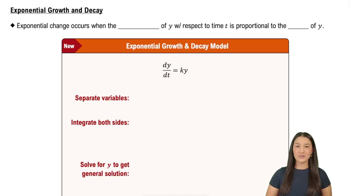
An exponential growth function models quantities that increase at a rate proportional to their current value, expressed as y(t) = y₀e^{kt}. Here, y₀ is the initial amount, k is the growth rate constant, and t is time. Understanding this form is essential to relate growth behavior to the rate constant.
Recommended video:
Exponential Growth & Decay
Doubling Time
Doubling time is the period required for a quantity undergoing exponential growth to double in size. It is related to the rate constant k by the formula T = ln(2)/k, where T is the doubling time. This relationship allows solving for k when the doubling time is known.
Recommended video:
Verifying Solutions of Differential Equations Example 3
Natural Logarithm and Solving for k
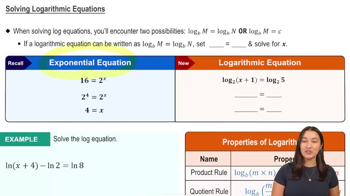
The natural logarithm (ln) is the inverse of the exponential function and is used to solve equations involving exponentials. To find k, take the natural logarithm of both sides of the doubling time equation, enabling isolation and calculation of k from known values.
Recommended video:
Solving Logarithmic Equations
Watch next
Master Exponential Functions with a bite sized video explanation from Patrick
Start learningRelated Videos
Related Practice
Multiple Choice
21
views