

Identify the inflection points and local maxima and minima of the functions graphed in Exercises 1–8. Identify the open intervals on which the functions are differentiable and the graphs are concave up and concave down.
8. y = 2cosx - √2x, -π≤x≤3π/2
Verified step by step guidance
Identify the inflection points and local maxima and minima of the functions graphed in Exercises 1–8. Identify the open intervals on which the functions are differentiable and the graphs are concave up and concave down.
8. y = 2cosx - √2x, -π≤x≤3π/2
10. Catching rainwater A 1125 ft^3 open-top rectangular tank with a square base x ft on a side and y ft deep is to be built with its top flush with the ground to catch runoff water. The costs associated with the tank involve not only the material from which the tank is made but also an excavation charge proportional to the product xy.
a. If the total cost is c=5(x^2+4xy) + 10xy, what values of x and y will minimize it?
b. Give a possible scenario for the cost function in part (a).
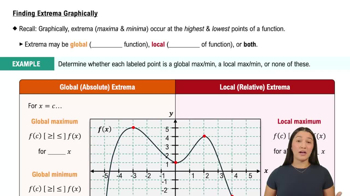
Finding Extrema from Graphs
In Exercises 7–10, find the absolute extreme values and where they occur.
Initial Value Problems
Solve the initial value problems in Exercises 71–90.
dr/dθ = −π sin (πθ), r(0) = 0
Motion with constant acceleration The standard equation for the position s of a body moving with a constant acceleration a along a coordinate line is s = (a/2)t² + v₀t + s₀, where v₀ and s₀ are the body’s velocity and position at time t = 0. Derive this equation by solving the initial value problem
Differential equation: d²s/dt² = a
Initial conditions: ds/dt = v₀ and s = s₀ when t=0.
Applications
A marathoner ran the 26.2-mi New York City Marathon in 2.2 hours. Show that at least twice the marathoner was running at exactly 11 mph, assuming the initial and final speeds are zero.