Ch. 8 - Integration Techniques
Briggs - Calculus: Early Transcendentals 3rd Edition
Briggs3rd EditionCalculus: Early TranscendentalsISBN: 9780136847243Not the one you use?Change textbook
Chapter 8, Problem 8.5.65a

65. Explain why or why not Determine whether the following statements are true and give an explanation or counterexample.
a. To evaluate ∫ (4x⁶)/(x⁴ + 3x²) dx, the first step is to find the partial fraction decomposition of the integrand.

Verified step by step guidance
1
First, examine the integrand \( \frac{4x^{6}}{x^{4} + 3x^{2}} \). Notice that both numerator and denominator are polynomials in terms of \( x \).
Check the degree of the numerator and denominator: the numerator has degree 6, and the denominator has degree 4. Since the degree of the numerator is higher, consider simplifying the integrand by polynomial division before attempting partial fraction decomposition.
Perform polynomial division of \( 4x^{6} \) by \( x^{4} + 3x^{2} \) to rewrite the integrand as a polynomial plus a proper rational function (where the numerator degree is less than the denominator degree).
After polynomial division, if the remaining rational function has a denominator that can be factored into linear or irreducible quadratic factors, then partial fraction decomposition can be applied to that part.
Therefore, the first step is not to directly find the partial fraction decomposition of the original integrand, but to simplify it first by polynomial division. This shows that the statement is false.

Verified video answer for a similar problem:

This video solution was recommended by our tutors as helpful for the problem above.
Video duration:
1m
Was this helpful?

Key Concepts

Here are the essential concepts you must grasp in order to answer the question correctly.

Partial Fraction Decomposition

Partial fraction decomposition is a technique used to break down rational functions into simpler fractions that are easier to integrate. It applies when the integrand is a ratio of polynomials where the degree of the numerator is less than the degree of the denominator. This method is not suitable if the numerator's degree is equal to or greater than the denominator's.
Recommended video:
10:07
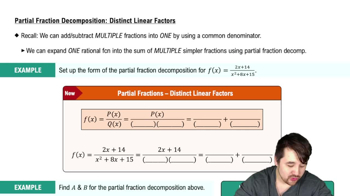
Partial Fraction Decomposition: Distinct Linear Factors

Polynomial Degree Comparison

Before applying partial fraction decomposition, compare the degrees of the numerator and denominator polynomials. If the numerator's degree is higher or equal, perform polynomial division first to rewrite the integrand as a polynomial plus a proper fraction. This step ensures the integrand fits the form required for partial fractions.
Recommended video:
07:00
Taylor Polynomials

Integration of Rational Functions

Integrating rational functions often involves simplifying the integrand through algebraic manipulation such as polynomial division or partial fractions. Recognizing the appropriate method depends on the form of the integrand, which guides the integration strategy and helps avoid unnecessary or incorrect steps.
Recommended video:
6:04
Intro to Rational Functions
Related Practice
Textbook Question

91. [Use of Tech] Regions bounded by exponentials Let a > 0 and let R be the region bounded by the graph of y = e^(-a·x) and the x-axis

on the interval [b, ∞).

a. Find A(a,b), the area of R as a function of a and b.

70
views

Textbook Question

Gamma function The gamma function is defined by Γ(p) = ∫ from 0 to ∞ of x^(p-1) e^(-x) dx, for p not equal to zero or a negative integer.

a. Use the reduction formula ∫ from 0 to ∞ of x^p e^(-x) dx = p ∫ from 0 to ∞ of x^(p-1) e^(-x) dx for p = 1, 2, 3, ...

to show that Γ(p + 1) = p! (p factorial).

109
views
Textbook Question

A piece of wood paneling must be cut in the shape shown in the figure.

The coordinates of several points on its curved surface are also shown (with units of inches).

a. Estimate the surface area of the paneling using the Trapezoid Rule.

37
views
Textbook Question

66–71. {Use of Tech} Estimating error Refer to Theorem 8.1 in the following exercises.

70. Let f(x) = e^(-x²).

a. Find a Simpson's Rule approximation to the integral from 0 to 3 of e^(-x²) dx using n = 30 subintervals.

41
views
Textbook Question

41-44. {Use of Tech} Nonuniform grids

Use the indicated methods to solve the following problems with nonuniform grids.

41. A curling iron is plugged into an outlet at time t = 0. Its temperature T in degrees Fahrenheit, assumed to be a continuous function that is strictly increasing and concave down on 0 ≤ t ≤ 120, is given at various times (in seconds) in the table.

a. Approximate (1/120)∫(0 to 120)T(t)dt in three ways using a left Riemann sum, using a right Riemann sum and using the Trapezoid Rule

Interpret the value of (1/120)∫(0 to 120)T(t)dt in the context of this problem.

64
views
Textbook Question

66–71. {Use of Tech} Estimating error Refer to Theorem 8.1 in the following exercises.

69. Let f(x) = sin(eˣ).

a. Find a Trapezoid Rule approximation to ∫[0 to 1] sin(eˣ) dx using n = 40 subintervals.

48
views