Ch. 5 - Integration
Briggs - Calculus: Early Transcendentals 3rd Edition
Briggs3rd EditionCalculus: Early TranscendentalsISBN: 9780136847243Not the one you use?Change textbook
Chapter 5, Problem 5.R.95

Displacement from velocity A particle moves along a line with a velocity given by v(t) = 5 sin πt, starting with an initial position s(0) = 0 . Find the displacement of the particle between t = 0 and t = 2 , which is given by s(t) = ∫₀² v(t) dt . Find the distance traveled by the particle during this interval, which is ∫₀² |v(t)| dt .

Verified step by step guidance
1
Step 1: Understand the problem. The displacement of the particle is calculated using the definite integral of the velocity function v(t) over the interval [0, 2]. The distance traveled is calculated using the definite integral of the absolute value of the velocity function |v(t)| over the same interval.
Step 2: Write the displacement formula. The displacement is given by s(t) = ∫₀² v(t) dt. Substitute v(t) = 5 sin(πt) into the integral: s(t) = ∫₀² 5 sin(πt) dt.
Step 3: Solve the integral for displacement. Use the integral rule for sine: ∫ sin(ax) dx = -(1/a) cos(ax) + C. Here, a = π, so the integral becomes ∫₀² 5 sin(πt) dt = -5/π [cos(πt)] evaluated from t = 0 to t = 2.
Step 4: Write the formula for distance traveled. The distance is given by ∫₀² |v(t)| dt. Since v(t) = 5 sin(πt), the absolute value |v(t)| must be considered. Analyze the behavior of sin(πt) over [0, 2] to determine where it is positive or negative, and split the integral accordingly.
Step 5: Solve the integral for distance. Break the integral into intervals where sin(πt) is positive and negative. For t ∈ [0, 1], sin(πt) ≥ 0, so |v(t)| = 5 sin(πt). For t ∈ [1, 2], sin(πt) < 0, so |v(t)| = -5 sin(πt). Compute ∫₀¹ 5 sin(πt) dt and ∫₁² -5 sin(πt) dt separately, then add the results to find the total distance traveled.

Verified video answer for a similar problem:

This video solution was recommended by our tutors as helpful for the problem above.
Video duration:
7m
Was this helpful?

Key Concepts

Here are the essential concepts you must grasp in order to answer the question correctly.

Velocity and Displacement

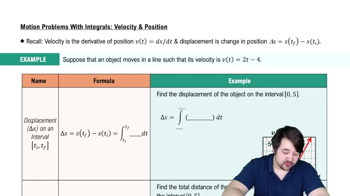
Velocity is the rate of change of position with respect to time, represented mathematically as v(t). Displacement refers to the change in position of a particle over a specific time interval, calculated by integrating the velocity function. In this case, the displacement is found by evaluating the integral of v(t) from t = 0 to t = 2.
Recommended video:
10:17
Using The Velocity Function

Definite Integral

A definite integral calculates the accumulation of quantities, such as area under a curve, over a specified interval. It is denoted as ∫ₐᵇ f(x) dx, where a and b are the limits of integration. In the context of this problem, the definite integral of the velocity function gives the displacement of the particle over the interval from t = 0 to t = 2.
Recommended video:
05:43
Definition of the Definite Integral

Absolute Value of Velocity

The absolute value of velocity, |v(t)|, represents the speed of the particle regardless of direction. When calculating the total distance traveled, it is essential to integrate the absolute value of the velocity function over the given interval. This ensures that any changes in direction do not cancel out the distance covered, providing a true measure of the path length.
Recommended video:
05:59
Initial Value Problems Example 2
Related Practice
Textbook Question

Area functions and the Fundamental Theorem Consider the function

ƒ(t) = { t      if  ―2 ≤ t < 0

t²/2    if    0 ≤ t ≤ 2

and its graph shown below. Let F(𝓍) = ∫₋₁ˣ ƒ(t) dt and G(𝓍) = ∫₋₂ˣ ƒ(t) dt.

(d) Evaluate F ' (―1) and F ' (1). Interpret these values.

78
views
Textbook Question

Evaluating integrals Evaluate the following integrals.


∫π/₁₂^π/⁹ (csc 3𝓍 cot 3𝓍 + sec 3𝓍 tan 3𝓍) d𝓍

42
views
Textbook Question

Use geometry and properties of integrals to evaluate the following definite integrals.                                                                                          


 ∫₀⁴ √(8𝓍―𝓍²) d𝓍 . (Hint: Complete the square .)

98
views
Textbook Question

Evaluating integrals Evaluate the following integrals.


∫₋₅⁵ ω³ /√(ω⁵⁰ + ω²⁰ + 1) dω (Hint: Use symmetry . )

59
views
Textbook Question

Area functions and the Fundamental Theorem Consider the function

ƒ(t) = { t      if  ―2 ≤ t < 0

t²/2    if    0 ≤ t ≤ 2

and its graph shown below. Let F(𝓍) = ∫₋₁ˣ ƒ(t) dt and G(𝓍) = ∫₋₂ˣ ƒ(t) dt.

(c) Use the Fundamental Theorem to find an expression for F '(𝓍) for 0 ≤ 𝓍 < 2.

57
views
Textbook Question

Evaluating integrals Evaluate the following integrals.                                                                                                                                         


 ∫ y² (3y³ + 1)⁴ dy

70
views