
Ch. 10 - Sequences and Infinite Series
Briggs - Calculus: Early Transcendentals 3rd Edition
Briggs3rd EditionCalculus: Early TranscendentalsISBN: 9780136847243Not the one you use?Change textbook
Chapter 10, Problem 10.4.47c

Explain why or why not Determine whether the following statements are true and give an explanation or counterexample.


c. Suppose f is a continuous, positive, decreasing function, for x ≥ 1, and aₖ = f(k), for k = 1, 2, 3, …. If ∑ (k = 1 to ∞) aₖ converges to L, then ∫ (1 to ∞) f(x) dx converges to L.

Verified step by step guidance
1
Step 1: Understand the problem statement. We have a function \(f\) that is continuous, positive, and decreasing for \(x \geq 1\), and a sequence \(a_k = f(k)\) for \(k = 1, 2, 3, \ldots\). The series \(\sum_{k=1}^\infty a_k\) converges to some limit \(L\). We need to determine if the improper integral \(\int_1^\infty f(x) \, dx\) also converges to the same limit \(L\).
Step 2: Recall the Integral Test for convergence of series. The Integral Test states that if \(f\) is continuous, positive, and decreasing on \([1, \infty)\), then the series \(\sum_{k=1}^\infty f(k)\) and the integral \(\int_1^\infty f(x) \, dx\) either both converge or both diverge. However, this test does not say that their sums or values are equal, only that their convergence behavior matches.
Step 3: Analyze the relationship between the sum and the integral. The sum \(S = \sum_{k=1}^\infty f(k)\) is a discrete sum of function values at integers, while the integral \(I = \int_1^\infty f(x) \, dx\) is the continuous area under the curve. Although both converge or diverge together, their exact values are generally not equal.
Step 4: Consider a counterexample to show the values are not necessarily equal. For example, take \(f(x) = \frac{1}{x^2}\). The series \(\sum_{k=1}^\infty \frac{1}{k^2}\) converges to \(\frac{\pi^2}{6}\), while the integral \(\int_1^\infty \frac{1}{x^2} \, dx\) converges to 1. Since \(\frac{\pi^2}{6} \neq 1\), the integral and series limits are not equal.
Step 5: Conclusion: The statement is false because although the series and integral both converge, the integral does not necessarily converge to the same limit \(L\) as the series. The Integral Test guarantees convergence behavior but not equality of sums and integrals.

Verified video answer for a similar problem:

This video solution was recommended by our tutors as helpful for the problem above.
Video duration:
1m
Was this helpful?

Key Concepts

Here are the essential concepts you must grasp in order to answer the question correctly.

Comparison between Series and Improper Integrals

This concept explores the relationship between infinite series and improper integrals, especially when terms of the series come from evaluating a function at integers. While both can converge or diverge, their exact values and convergence behavior may differ, requiring careful analysis to determine equivalence.
Recommended video:
11:11
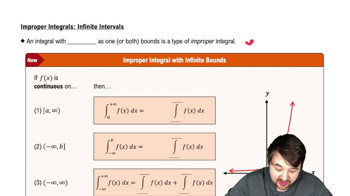
Improper Integrals: Infinite Intervals

Integral Test for Convergence

The integral test links the convergence of a series with positive, decreasing terms to the convergence of an improper integral of the corresponding function. It states that if the integral converges, so does the series, and vice versa, but it does not guarantee that their sums or values are equal.
Recommended video:
07:51
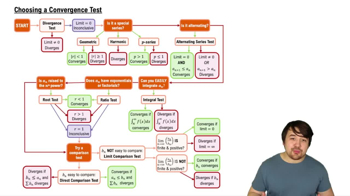
Choosing a Convergence Test

Counterexamples in Convergence Analysis

Counterexamples demonstrate that even when conditions like positivity, continuity, and monotonicity hold, the sum of a series and the value of the corresponding improper integral may not be equal. Such examples help clarify the limits of theorems and prevent incorrect assumptions about equality of limits.
Recommended video:
07:51
Choosing a Convergence Test
Related Practice
Textbook Question

67–70. Formulas for sequences of partial sums Consider the following infinite series.


c.Make a conjecture for the value of the series.


∑⁽∞⁾ₖ₌₁2⁄[(2k − 1)(2k + 1)]

92
views
Textbook Question

{Use of Tech} A savings plan

James begins a savings plan in which he deposits \(100 at the beginning of each month into an account that earns 9% interest annually, or equivalently, 0.75% per month.

To be clear, on the first day of each month, the bank adds 0.75% of the current balance as interest, and then James deposits \)100.


Let Bₙ be the balance in the account after the nᵗʰ payment, where B₀ = \(0.


c.How many months are needed to reach a balance of \)5000?

43
views
Textbook Question

Explain why or why not

Determine whether the following statements are true and give an explanation or counterexample.


c.The convergent sequences {aₙ} and {bₙ} differ in their first 100 terms, but aₙ = bₙ for n > 100.

It follows that limₙ→∞aₙ = limₙ→∞bₙ.

58
views
Textbook Question

Explain why or why not Determine whether the following statements are true and give an explanation or counterexample.


c. If lim (as k → ∞) ᵏ√|aₖ| = 1/4, then ∑ 10aₖ converges absolutely.

61
views
Textbook Question

{Use of Tech} Periodic dosing

Many people take aspirin on a regular basis as a preventive measure for heart disease. Suppose a person takes 80 mg of aspirin every 24 hours. Assume aspirin has a half-life of 24 hours; that is, every 24 hours, half of the drug in the blood is eliminated.


c.Assuming the sequence has a limit, confirm the result of part (b) by finding the limit of {dₙ} directly.

44
views
Textbook Question

41–44. {Use of Tech} Remainders and estimates Consider the following convergent series.


c. Find lower and upper bounds (Lₙ and Uₙ, respectively) on the exact value of the series.


43. ∑ (k = 1 to ∞) 1 / 3ᵏ

147
views