
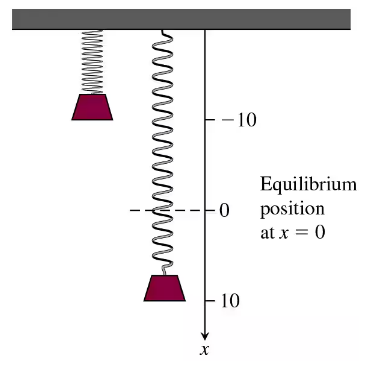
A weight is attached to a spring and reaches its equilibrium position (x = 0). It is then set in motion resulting in a displacement of x = 10 cos t, where x is measured in centimeters and t is measured in seconds. See the accompanying figure. b. Find the spring’s velocity when t = 0, t = π/3, and t = 3π/4.
Verified step by step guidance
1
To find the velocity of the spring, we need to differentiate the displacement function with respect to time. The displacement function given is x(t) = 10 cos(t).
The velocity function v(t) is the derivative of the displacement function x(t) with respect to time t. So, we need to compute the derivative of x(t) = 10 cos(t).
Using the derivative rule for cosine, which is d/dt [cos(t)] = -sin(t), we find that the derivative of x(t) = 10 cos(t) is v(t) = -10 sin(t).
Now, substitute the given values of t into the velocity function v(t) = -10 sin(t) to find the velocity at specific times. First, substitute t = 0 into v(t) to find the velocity at t = 0.
Next, substitute t = π/3 and t = 3π/4 into v(t) = -10 sin(t) to find the velocities at these times. Remember to evaluate the sine function at these angles to complete the calculation.
Verified video answer for a similar problem:
This video solution was recommended by our tutors as helpful for the problem above
Video duration:
1m
Play a video:
Was this helpful?
Key Concepts
Here are the essential concepts you must grasp in order to answer the question correctly.
Simple Harmonic Motion (SHM)
Simple Harmonic Motion is a type of periodic motion where an object oscillates around an equilibrium position. In this case, the weight attached to the spring moves according to the equation x = 10 cos(t), indicating that its displacement varies with time in a cosine function, which is characteristic of SHM.
The velocity of an object in Simple Harmonic Motion can be derived from its displacement function. It is calculated by taking the derivative of the displacement with respect to time. For the given function x(t) = 10 cos(t), the velocity v(t) is given by v(t) = -10 sin(t), which indicates how fast and in which direction the object is moving at any time t.
Trigonometric functions, such as sine and cosine, are fundamental in describing oscillatory motion. They relate angles to ratios of sides in right triangles and are periodic functions. In this context, they help model the displacement and velocity of the spring system over time, allowing for the calculation of these values at specific instances.