2–74. Integration techniques Use the methods introduced in Sections 8.1 through 8.5 to evaluate the following integrals. 46. ∫ (x³ + 4x² + 12x + 4)/((x² + 4x + 10)²) dx
Verified step by step guidance
1
First, recognize that the denominator is a quadratic expression squared: \((x^2 + 4x + 10)^2\). It might help to complete the square for the quadratic in the denominator to simplify the integral. Complete the square for \(x^2 + 4x + 10\) by rewriting it as \((x + 2)^2 + 6\).
Next, perform a substitution to simplify the integral. Let \(u = x^2 + 4x + 10\). Then, compute \(du = (2x + 4) dx\). This substitution will help express parts of the numerator in terms of \(u\) and \(du\).
Rewrite the numerator \(x^3 + 4x^2 + 12x + 4\) in terms of \(x\) and \(u\) to see if it can be expressed as a combination of \(du\) and \(u\). This often involves expressing the numerator as \(A(2x + 4) + B\) or similar, to match the derivative \(du\).
Split the integral into two parts based on the decomposition of the numerator: one part involving \(du\) over \(u^2\), and the other part involving a simpler rational function. This allows you to integrate each part separately using standard integral formulas.
Finally, integrate each part using the power rule for integrals and the formula for integrals of the form \(\int \frac{du}{u^2}\), then substitute back \(u = x^2 + 4x + 10\) to express the answer in terms of \(x\).
Verified video answer for a similar problem:
This video solution was recommended by our tutors as helpful for the problem above
Video duration:
13m
Play a video:
0 Comments
Key Concepts
Here are the essential concepts you must grasp in order to answer the question correctly.
Polynomial Long Division and Simplification
Before integrating rational functions, it is often helpful to simplify the integrand by performing polynomial long division if the numerator's degree is equal to or greater than the denominator's. This can reduce the integral into simpler terms or a sum of simpler fractions, making the integration process more manageable.
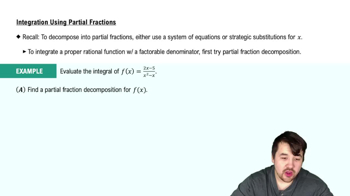
Partial fraction decomposition breaks a complex rational function into a sum of simpler fractions that are easier to integrate. For repeated quadratic factors in the denominator, the decomposition includes terms with linear numerators over powers of the quadratic, which helps in systematically integrating each part.
When integrating functions with quadratic expressions in the denominator, completing the square and using substitutions or standard integral formulas involving arctangent or logarithmic functions are common. Recognizing these forms allows the use of known antiderivatives to evaluate the integral efficiently.