

Ch. 3 - Derivatives
Hass - Thomas' Calculus 15th Edition
Hass15th EditionThomas' CalculusISBN: 9780137616077Not the one you use?Change textbook
Chapter 3, Problem 18b

Understanding Motion from Graphs


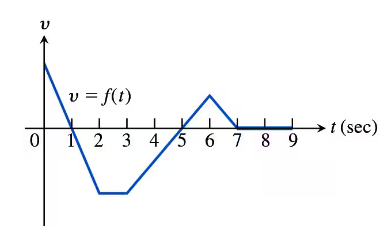
The accompanying figure shows the velocity v = f(t) of a particle moving on a horizontal coordinate line.


b. When is the particle’s acceleration positive? Negative? Zero?
graph

Verified step by step guidance
1
To determine when the particle's acceleration is positive, negative, or zero, we need to analyze the graph of velocity v = f(t) with respect to time t. Acceleration is the derivative of velocity, so we are looking for the slope of the velocity graph.
Acceleration is positive when the slope of the velocity graph is positive, meaning the graph is increasing. Look for intervals where the graph is rising as time progresses.
Acceleration is negative when the slope of the velocity graph is negative, meaning the graph is decreasing. Identify intervals where the graph is falling as time progresses.
Acceleration is zero when the slope of the velocity graph is zero, meaning the graph is flat or horizontal. Find intervals where the graph is constant and not changing with time.
Examine the graph: From t = 0 to t = 1, the graph is decreasing, indicating negative acceleration. From t = 1 to t = 2, the graph is increasing, indicating positive acceleration. From t = 2 to t = 4, the graph is flat, indicating zero acceleration. Continue this analysis for the entire graph to identify all intervals of positive, negative, and zero acceleration.

Verified video answer for a similar problem:

This video solution was recommended by our tutors as helpful for the problem above.
Video duration:
2m
Was this helpful?

Key Concepts

Here are the essential concepts you must grasp in order to answer the question correctly.

Velocity and Acceleration

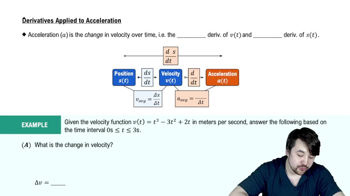
Velocity is the rate of change of position with respect to time, represented as the function v = f(t) in the graph. Acceleration, on the other hand, is the rate of change of velocity with respect to time. When analyzing motion, understanding how velocity changes helps determine when the acceleration is positive (velocity increasing), negative (velocity decreasing), or zero (constant velocity).
Recommended video:
06:15
Derivatives Applied To Acceleration

Graph Interpretation

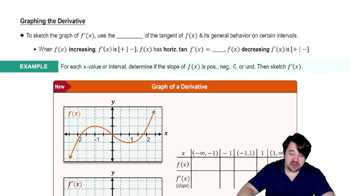
Interpreting graphs is crucial in calculus, especially for understanding motion. The graph of velocity versus time shows how the velocity of the particle changes over time. The slope of the velocity graph indicates acceleration: a positive slope means positive acceleration, a negative slope indicates negative acceleration, and a horizontal line (zero slope) signifies zero acceleration.
Recommended video:
06:15
Graphing The Derivative

Critical Points and Intervals

Critical points on the velocity graph occur where the graph changes direction, which can indicate changes in acceleration. By identifying intervals where the graph is increasing or decreasing, one can determine when the particle's acceleration is positive, negative, or zero. This analysis is essential for answering questions about the motion of the particle over time.
Recommended video:
04:50
Critical Points
Related Practice
Textbook Question

Understanding Motion from Graphs


Launching a Rocket When a model rocket is launched, the propellant burns for a few seconds, accelerating the rocket upward. After burnout, the rocket coasts upward for a while and then begins to fall. A small explosive charge pops out a parachute shortly after the rocket starts down. The parachute slows the rocket to keep it from breaking when it lands.


The figure here shows velocity data from the flight of the model rocket. Use the data to answer the following.


d. When did the parachute pop out? How fast was the rocket falling then?


213
views
Textbook Question

Understanding Motion from Graphs


Launching a Rocket When a model rocket is launched, the propellant burns for a few seconds, accelerating the rocket upward. After burnout, the rocket coasts upward for a while and then begins to fall. A small explosive charge pops out a parachute shortly after the rocket starts down. The parachute slows the rocket to keep it from breaking when it lands.


The figure here shows velocity data from the flight of the model rocket. Use the data to answer the following.


f. When was the rocket’s acceleration greatest?


224
views
Textbook Question

Understanding Motion from Graphs


The accompanying figure shows the velocity v = f(t) of a particle moving on a horizontal coordinate line.


a. When does the particle move forward? Move backward? Speed up? Slow down?

232
views
Textbook Question

Understanding Motion from Graphs


The accompanying figure shows the velocity v = f(t) of a particle moving on a horizontal coordinate line.


c. When does the particle move at its greatest speed?

214
views
Textbook Question

Understanding Motion from Graphs


The accompanying figure shows the velocity v = f(t) of a particle moving on a horizontal coordinate line.


d. When does the particle stand still for more than an instant?

247
views
Textbook Question

In Exercises 19–22, find the values of the derivatives.


dr/dθ |θ₌₀ if r = 2/√(4 – θ)

151
views