Ch. 3 - Derivatives
Hass - Thomas' Calculus 15th Edition
Hass15th EditionThomas' CalculusISBN: 9780137616077Not the one you use?Change textbook
Chapter 3, Problem 3.4.11

Finding g on a small airless planet Explorers on a small airless planet used a spring gun to launch a ball bearing vertically upward from the surface at a launch velocity of 15 m/sec. Because the acceleration of gravity at the planet’s surface was gₛ m/sec², the explorers expected the ball bearing to reach a height of s = 15t − (1/2)gₛt² m t sec later. The ball bearing reached its maximum height 20 sec after being launched. What was the value of gₛ?

Verified step by step guidance
1
To find the value of gₛ, we need to determine when the ball bearing reaches its maximum height. The maximum height is reached when the velocity of the ball bearing is zero.
The velocity function v(t) is the derivative of the height function s(t) with respect to time t. So, differentiate s(t) = 15t - (1/2)gₛt² with respect to t to find v(t).
The derivative of s(t) with respect to t is v(t) = ds/dt = 15 - gₛt.
Set the velocity function v(t) to zero to find the time at which the maximum height is reached: 0 = 15 - gₛt.
Solve the equation 0 = 15 - gₛt for t = 20 seconds to find gₛ. This gives gₛ = 15/20.

Verified video answer for a similar problem:

This video solution was recommended by our tutors as helpful for the problem above.
Video duration:
3m
Was this helpful?

Key Concepts

Here are the essential concepts you must grasp in order to answer the question correctly.

Kinematic Equations

Kinematic equations describe the motion of objects under constant acceleration. In this problem, the equation s = 15t − (1/2)gₛt² represents the height of the ball bearing as a function of time, where 15 m/sec is the initial velocity and gₛ is the gravitational acceleration. Understanding these equations helps in determining the relationship between time, velocity, and acceleration.
Recommended video:
5:02
Solving Logarithmic Equations

Maximum Height in Projectile Motion

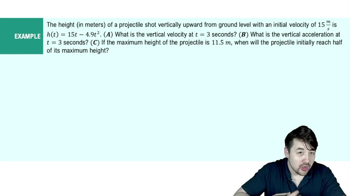
The maximum height in projectile motion occurs when the vertical velocity of the object becomes zero. At this point, the object stops ascending and begins to descend. In the given problem, the ball bearing reaches its maximum height at 20 seconds, which is crucial for calculating the gravitational acceleration by setting the derivative of the height equation to zero.
Recommended video:
06:51
Derivatives Applied To Acceleration Example 2

Solving Quadratic Equations

Solving quadratic equations is essential for finding unknown variables in kinematic problems. The height equation s = 15t − (1/2)gₛt² is quadratic in form. By setting the derivative of this equation to zero, we can solve for gₛ, the gravitational acceleration, using the known time at which the maximum height is reached.
Recommended video:
5:02
Solving Logarithmic Equations