In Exercises 31–36, find all possible functions with the given derivative.
b. y′ = x²
Verified step by step guidance
1
To find the original function from its derivative, we need to perform integration. The given derivative is \( y' = x^2 \).
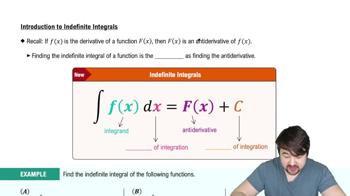
The process of finding the original function is called integration. We need to integrate \( x^2 \) with respect to \( x \).
The integral of \( x^n \) is \( \frac{x^{n+1}}{n+1} + C \), where \( C \) is the constant of integration. Here, \( n = 2 \).
Apply the power rule for integration: \( \int x^2 \, dx = \frac{x^{2+1}}{2+1} + C = \frac{x^3}{3} + C \).
Thus, the original function \( y \) is \( y = \frac{x^3}{3} + C \), where \( C \) is any constant, representing the family of functions with the given derivative.
Verified video answer for a similar problem:
This video solution was recommended by our tutors as helpful for the problem above
Video duration:
2m
Play a video:
0 Comments
Key Concepts
Here are the essential concepts you must grasp in order to answer the question correctly.
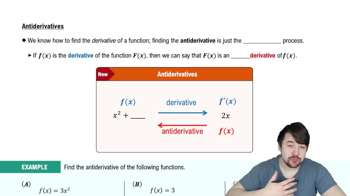
Antiderivatives
An antiderivative of a function is another function whose derivative is the original function. To find a function from its derivative, we perform the process of integration, which is essentially finding the antiderivative. For example, if y' = x², the antiderivative is y = (1/3)x³ + C, where C is the constant of integration.
Indefinite integration is the process of finding the antiderivative of a function. It involves integrating the function without specific limits, resulting in a general form that includes a constant of integration, C. This constant accounts for all possible vertical shifts of the antiderivative, reflecting the family of functions that share the same derivative.
The constant of integration, denoted as C, arises when performing indefinite integration. It represents an arbitrary constant added to the antiderivative, accounting for the fact that multiple functions can have the same derivative. For example, if y' = x², the antiderivative is y = (1/3)x³ + C, where C can be any real number.