In Exercises 31–36, find all possible functions with the given derivative.
a. y′ = −1 / x²
Verified step by step guidance
1
Step 1: Recognize that the problem asks for the original function given its derivative, y′ = −1 / x². This means we need to find the antiderivative or integral of the given derivative.
Step 2: Set up the integral to find the function y. The integral of y′ with respect to x is ∫(-1/x²) dx.
Step 3: Simplify the integrand. Note that -1/x² can be rewritten as -x⁻², which is a form that is easier to integrate.
Step 4: Apply the power rule for integration. The power rule states that ∫xⁿ dx = (xⁿ⁺¹)/(n+1) + C, where C is the constant of integration. For -x⁻², n = -2, so integrate using this rule.
Step 5: After applying the power rule, simplify the expression to find the general form of the function y(x). Don't forget to include the constant of integration, C, which represents all possible functions that have the given derivative.
Verified video answer for a similar problem:
This video solution was recommended by our tutors as helpful for the problem above
Video duration:
2m
Play a video:
0 Comments
Key Concepts
Here are the essential concepts you must grasp in order to answer the question correctly.
Antiderivatives
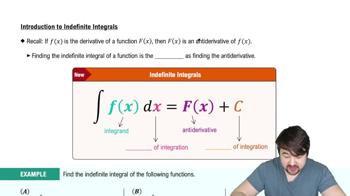
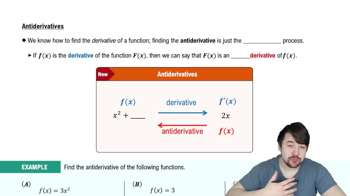
Antiderivatives, or indefinite integrals, are functions that reverse the process of differentiation. To find a function from its derivative, you need to determine its antiderivative. This involves integrating the derivative function, which in this case is y′ = −1/x², to find the original function y(x).
Integration techniques are methods used to find antiderivatives. For the derivative y′ = −1/x², you can use the power rule for integration, which states that ∫x^n dx = x^(n+1)/(n+1) + C, where C is the constant of integration. Applying this rule helps find the function whose derivative is given.
The constant of integration, denoted as C, is an arbitrary constant added to the antiderivative. It accounts for the fact that differentiation of a constant yields zero, meaning multiple functions can have the same derivative. When finding functions from derivatives, including C ensures all possible functions are considered.