Cubic functions Consider the cubic function f(x) = ax³ + bx² + cx + d.
b. How many local extreme values can f have?
Verified step by step guidance
1
To determine the number of local extreme values a cubic function can have, we first need to find its critical points. Critical points occur where the derivative of the function is zero or undefined.
Calculate the derivative of the cubic function f(x) = ax³ + bx² + cx + d. The derivative, f'(x), is given by: .
Set the derivative f'(x) equal to zero to find the critical points: . Solve this quadratic equation for x.
A quadratic equation can have at most two real roots, which means the cubic function can have at most two critical points. Each critical point is a candidate for a local extreme value.
To determine if these critical points are local maxima or minima, use the second derivative test. Calculate the second derivative, f''(x), and evaluate it at each critical point. If f''(x) is positive at a critical point, it is a local minimum; if negative, it is a local maximum.
Verified video answer for a similar problem:
This video solution was recommended by our tutors as helpful for the problem above
Video duration:
4m
Play a video:
0 Comments
Key Concepts
Here are the essential concepts you must grasp in order to answer the question correctly.
Cubic Functions
Cubic functions are polynomial functions of degree three, represented in the form f(x) = ax³ + bx² + cx + d, where a, b, c, and d are constants and a ≠ 0. The shape of the graph can vary significantly based on the coefficients, leading to different behaviors in terms of local extrema and inflection points.
Local extreme values refer to points in the function where it reaches a local maximum or minimum. For cubic functions, these points occur where the first derivative of the function equals zero, indicating potential changes in the direction of the graph. The number of local extrema can vary based on the function's specific coefficients.
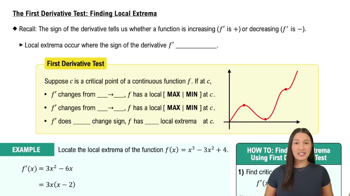
The First Derivative Test is a method used to determine the local extrema of a function. By finding the derivative of the function and setting it to zero, we can identify critical points. Analyzing the sign of the derivative before and after these points helps classify them as local maxima, minima, or points of inflection.