
Ch. 4 - Applications of Derivatives
Hass - Thomas' Calculus 15th Edition
Hass15th EditionThomas' CalculusISBN: 9780137616077Not the one you use?Change textbook
Chapter 4, Problem 4.3.37

Identifying Extrema


In Exercises 19–40:


a. Find the open intervals on which the function is increasing and those on which it is decreasing.


b. Identify the function’s local extreme values, if any, saying where they occur.


f(x) = x¹ᐟ³(x + 8)

Verified step by step guidance
1
To determine where the function \( f(x) = x^{1/3}(x + 8) \) is increasing or decreasing, first find its derivative \( f'(x) \). Use the product rule: if \( u(x) = x^{1/3} \) and \( v(x) = x + 8 \), then \( f'(x) = u'(x)v(x) + u(x)v'(x) \).
Calculate \( u'(x) \) and \( v'(x) \). For \( u(x) = x^{1/3} \), use the power rule to find \( u'(x) = \frac{1}{3}x^{-2/3} \). For \( v(x) = x + 8 \), \( v'(x) = 1 \).
Substitute \( u'(x) \), \( v(x) \), \( u(x) \), and \( v'(x) \) into the product rule formula: \( f'(x) = \frac{1}{3}x^{-2/3}(x + 8) + x^{1/3}(1) \). Simplify this expression to find \( f'(x) \).
Find the critical points by setting \( f'(x) = 0 \) and solving for \( x \). These points, along with any points where \( f'(x) \) is undefined, will help determine intervals of increase and decrease.
Analyze the sign of \( f'(x) \) on the intervals determined by the critical points. If \( f'(x) > 0 \), the function is increasing on that interval; if \( f'(x) < 0 \), it is decreasing. Use this information to identify any local extrema by checking the sign changes of \( f'(x) \).

Verified video answer for a similar problem:

This video solution was recommended by our tutors as helpful for the problem above.
Video duration:
7m
Was this helpful?

Key Concepts

Here are the essential concepts you must grasp in order to answer the question correctly.

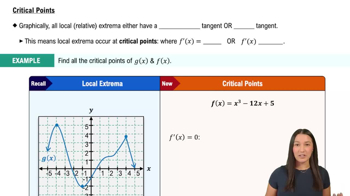
Derivative and Critical Points

The derivative of a function provides information about its rate of change. To find where a function is increasing or decreasing, calculate its derivative and identify critical points where the derivative is zero or undefined. These points are potential locations for local extrema and help determine intervals of increase or decrease.
Recommended video:
04:50
Critical Points

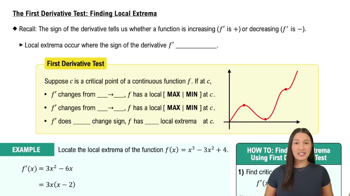
First Derivative Test

The First Derivative Test is used to determine whether a critical point is a local maximum, minimum, or neither. By analyzing the sign of the derivative before and after a critical point, one can ascertain the behavior of the function: if the derivative changes from positive to negative, the point is a local maximum; if it changes from negative to positive, it's a local minimum.
Recommended video:
07:09
The First Derivative Test: Finding Local Extrema

Interval Analysis

Interval analysis involves examining the sign of the derivative over different intervals to determine where the function is increasing or decreasing. By testing points within each interval, one can confirm the behavior of the function, ensuring a comprehensive understanding of its overall shape and identifying any local extrema.
Recommended video:
02:59
Finding Area Between Curves that Cross on the Interval