

Ch. 4 - Applications of Derivatives
Hass - Thomas' Calculus 15th Edition
Hass15th EditionThomas' CalculusISBN: 9780137616077Not the one you use?Change textbook
Chapter 4, Problem 4.3.68a

Theory and Examples


Sketch the graph of a differentiable function y = f(x) that has a local minimum at (1, 1) and a local maximum at (3, 3).

Verified step by step guidance
1
Start by understanding the behavior of the function around the local minimum and maximum. A local minimum at (1, 1) means that the derivative changes from negative to positive at x = 1, indicating a 'valley' in the graph. Similarly, a local maximum at (3, 3) means the derivative changes from positive to negative at x = 3, indicating a 'peak'.
Consider the general shape of the graph. Between x = 1 and x = 3, the function should increase to reach the local maximum at (3, 3). Before x = 1 and after x = 3, the function should decrease, reflecting the local minimum and maximum respectively.
Sketch the graph starting from the left of x = 1. The function should decrease until it reaches the point (1, 1). At this point, the slope of the tangent line is zero, indicating a local minimum.
From x = 1 to x = 3, sketch the graph such that it increases to reach the local maximum at (3, 3). At this point, the slope of the tangent line is zero again, indicating a local maximum.
Finally, sketch the graph beyond x = 3, where the function should decrease again. Ensure the graph reflects the change in slope at the local minimum and maximum points, creating a smooth curve that is differentiable everywhere.

Verified video answer for a similar problem:

This video solution was recommended by our tutors as helpful for the problem above.
Video duration:
2m
Was this helpful?

Key Concepts

Here are the essential concepts you must grasp in order to answer the question correctly.

Differentiable Function

A differentiable function is one that has a derivative at every point in its domain. This means the function is smooth and continuous, without any sharp corners or cusps. Understanding differentiability is crucial for sketching graphs, as it ensures the function's behavior can be predicted using its derivative.
Recommended video:
05:53
Finding Differentials

Local Minimum and Maximum

A local minimum is a point where the function value is lower than all nearby points, while a local maximum is where the function value is higher than all nearby points. These points are critical in graph sketching, as they indicate where the function changes direction, often corresponding to where the derivative equals zero.
Recommended video:
06:02
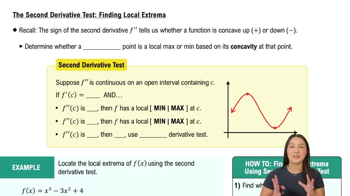
The Second Derivative Test: Finding Local Extrema

Critical Points and Derivatives

Critical points occur where the derivative of a function is zero or undefined, indicating potential local minima or maxima. Analyzing the derivative helps determine the nature of these points, guiding the sketching of the function's graph by showing where it increases or decreases.
Recommended video:
04:50
Critical Points