
Textbook Question
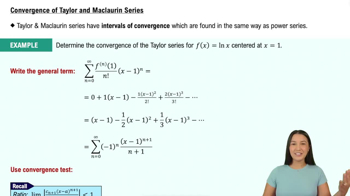
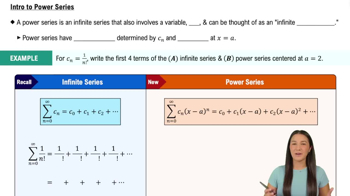
Radius and interval of convergence Determine the radius and interval of convergence of the following power series.
∑ₖ₌₀∞ (2x)ᵏ
34
views

 Verified step by step guidance
 08:26
08:26
 05:58
05:58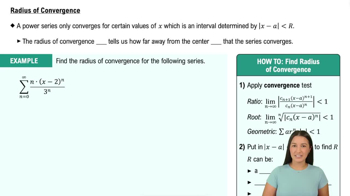 07:36
07:36Radius and interval of convergence Determine the radius and interval of convergence of the following power series.
∑ₖ₌₀∞ (2x)ᵏ
{Use of Tech} A different kind of approximation When approximating a function f using a Taylor polynomial, we use information about f and its derivative at one point. An alternative approach (called interpolation) uses information about f at several different points. Suppose we wish to approximate f(x)=sin x on the interval [0, π].
a. Write the (quadratic) Taylor polynomial p₂ for f centered at π/2.
b. Now consider a quadratic interpolating polynomial q(x) = ax² + bx + c. The coefficients a, b, and c are chosen such that the following conditions are satisfied:
q(0) = f(0), q(π/2) = f(π/2), and q(π) = f(π)
Show that q(x) = −(4/π²)x² + (4/π)x.
c. Graph f, p₂, and q on [0, π].
d. Find the error in approximating f(x) = sin x at the points π/4, π/2, 3π/4, and π using p₂ and q.
e. Which function, p₂ or q, is a better approximation to f on [0, π]? Explain.
{Use of Tech} Estimating errors Use the remainder to find a bound on the error in approximating the following quantities with the nth-order Taylor polynomial centered at 0. Estimates are not unique.
ln 1.04, n=3
Probability: tossing for a head The expected (average) number of tosses of a fair coin required to obtain the first head is ∑ₖ₌₁∞ k(1/2)ᵏ. Evaluate this series and determine the expected number of tosses. (Hint: Differentiate a geometric series.)
{Use of Tech} Estimating errors Use the remainder to find a bound on the error in approximating the following quantities with the nth-order Taylor polynomial centered at 0. Estimates are not unique.
sin 0.3, n = 4
Any method
a. Use any analytical method to find the first four nonzero terms of the Taylor series centered at 0 for the following functions. You do not need to use the definition of the Taylor series coefficients.
b. Determine the radius of convergence of the series.
f(x) = (1 + x²)⁻²/³