
Find a Taylor series for f centered at 2 given that f⁽ᵏ⁾(2)=1, for all nonnegative integers k.
Verified step by step guidance
1
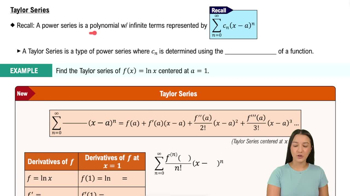
Recall the general formula for the Taylor series of a function \(f\) centered at \(a\):
\[f(x) = \sum_{k=0}^{\infty} \frac{f^{(k)}(a)}{k!} (x - a)^k,\] where \(f^{(k)}(a)\) is the \(k\)-th derivative of \(f\) evaluated at \(a\).
In this problem, the center is \(a = 2\), and we are given that for all nonnegative integers \(k\),
\[f^{(k)}(2) = 1.\]
Substitute the given derivative values into the Taylor series formula:
\[f(x) = \sum_{k=0}^{\infty} \frac{1}{k!} (x - 2)^k.\]
Recognize that this series matches the expansion of the exponential function \(e^y = \sum_{k=0}^{\infty} \frac{y^k}{k!}\), where \(y = x - 2\).
Therefore, the Taylor series for \(f\) centered at 2 can be expressed as
\[f(x) = \sum_{k=0}^{\infty} \frac{(x - 2)^k}{k!}.\] This is the series representation of \(e^{x-2}\), but since the problem only asks for the Taylor series, this summation form is the key result.
Verified video answer for a similar problem:
This video solution was recommended by our tutors as helpful for the problem above
Video duration:
1m
Play a video:
Was this helpful?
Key Concepts
Here are the essential concepts you must grasp in order to answer the question correctly.
Taylor Series Expansion
A Taylor series represents a function as an infinite sum of terms calculated from the derivatives of the function at a single point. Centered at a point a, it approximates the function near a using powers of (x - a) weighted by the function's derivatives at a.
The coefficients of a Taylor series are determined by the function's derivatives at the center point. Specifically, the k-th term involves the k-th derivative evaluated at the center, divided by k factorial, multiplied by (x - a)^k.
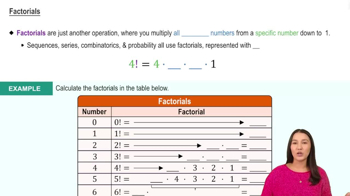
Factorials (k!) appear in the denominator of each Taylor series term to normalize the contribution of the k-th derivative. This ensures the series converges properly and accurately represents the function near the center.