Golden Gate Bridge Completed in 1937, San Francisco’s Golden Gate Bridge is 2.7 km long and weighs about 890,000 tons. The length of the span between the two central towers is 1280 m; the towers themselves extend 152 m above the roadway. The cables that support the deck of the bridge between the two towers hang in a parabola (see figure). Assuming the origin is midway between the towers on the deck of the bridge, find an equation that describes the cables. How long is a guy wire that hangs vertically from the cables to the roadway 500 m from the center of the bridge?
Table of contents
- 0. Functions7h 54m
- Introduction to Functions16m
- Piecewise Functions10m
- Properties of Functions9m
- Common Functions1h 8m
- Transformations5m
- Combining Functions27m
- Exponent rules32m
- Exponential Functions28m
- Logarithmic Functions24m
- Properties of Logarithms36m
- Exponential & Logarithmic Equations35m
- Introduction to Trigonometric Functions38m
- Graphs of Trigonometric Functions44m
- Trigonometric Identities47m
- Inverse Trigonometric Functions48m
- 1. Limits and Continuity2h 2m
- 2. Intro to Derivatives1h 33m
- 3. Techniques of Differentiation3h 18m
- 4. Applications of Derivatives2h 38m
- 5. Graphical Applications of Derivatives6h 2m
- 6. Derivatives of Inverse, Exponential, & Logarithmic Functions2h 37m
- 7. Antiderivatives & Indefinite Integrals1h 26m
- 8. Definite Integrals4h 44m
- 9. Graphical Applications of Integrals2h 27m
- 10. Physics Applications of Integrals 3h 16m
- 11. Integrals of Inverse, Exponential, & Logarithmic Functions2h 34m
- 12. Techniques of Integration7h 41m
- 13. Intro to Differential Equations2h 55m
- 14. Sequences & Series5h 36m
- 15. Power Series2h 19m
- 16. Parametric Equations & Polar Coordinates7h 58m
16. Parametric Equations & Polar Coordinates
Conic Sections
Problem 12.R.70
Textbook Question
Conic parameters: A hyperbola has eccentricity e = 2 and foci (0, ±2). Find the location of the vertices and directrices.
Verified step by step guidance1
Identify the given parameters: eccentricity \(e = 2\) and foci at \((0, \pm 2)\). Since the foci lie on the y-axis, the hyperbola is vertical with center at the origin \((0,0)\).
Recall the relationship between the center, foci, and vertices for a vertical hyperbola: the foci are at \((0, \pm c)\) and the vertices are at \((0, \pm a)\), where \(c\) is the focal distance and \(a\) is the distance from the center to each vertex.
From the foci coordinates, determine \(c\): since the foci are at \((0, \pm 2)\), we have \(c = 2\).
Use the eccentricity formula for a hyperbola: \(e = \frac{c}{a}\). Given \(e = 2\) and \(c = 2\), solve for \(a\) by rearranging to \(a = \frac{c}{e}\).
Find the directrices using the formula for vertical hyperbolas: the directrices are horizontal lines given by \(y = \pm \frac{a}{e}\). Substitute the values of \(a\) and \(e\) to find their locations.
Verified video answer for a similar problem:This video solution was recommended by our tutors as helpful for the problem above
Video duration:
3mPlay a video:
Was this helpful?
Key Concepts
Here are the essential concepts you must grasp in order to answer the question correctly.
Eccentricity of a Hyperbola
Eccentricity (e) measures how much a conic section deviates from being circular. For a hyperbola, e > 1, and it relates the distances between the foci and vertices. It is defined as e = c/a, where c is the distance from the center to a focus, and a is the distance from the center to a vertex.
Recommended video:
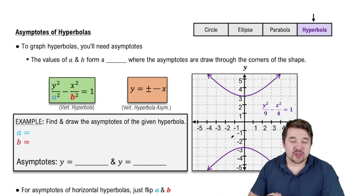
Asymptotes of Hyperbolas
Standard Form and Parameters of a Hyperbola
A hyperbola centered at the origin with vertical transverse axis has foci at (0, ±c) and vertices at (0, ±a). The relationship c² = a² + b² holds, where b relates to the conjugate axis. Knowing c and e allows calculation of a and b, which determine the shape and key points of the hyperbola.
Recommended video:
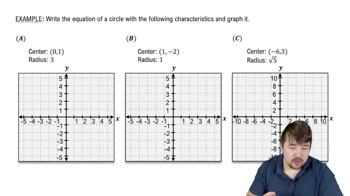
Circles in Standard Form Example 1
Directrices of a Hyperbola
Directrices are fixed lines used to define a hyperbola via eccentricity. For a hyperbola with vertical transverse axis, the directrices are horizontal lines located at y = ±(a/e). They help in understanding the geometric definition and are essential for graphing and analyzing the hyperbola.
Recommended video:
Asymptotes of Hyperbolas
Watch next
Master Geometries from Conic Sections with a bite sized video explanation from Patrick
Start learningRelated Videos
Related Practice
Textbook Question
10
views