

Ch. 6 - Applications of Integration
Briggs - Calculus: Early Transcendentals 3rd Edition
Briggs3rd EditionCalculus: Early TranscendentalsISBN: 9780136847243Not the one you use?Change textbook
Chapter 6, Problem 6.1.46c

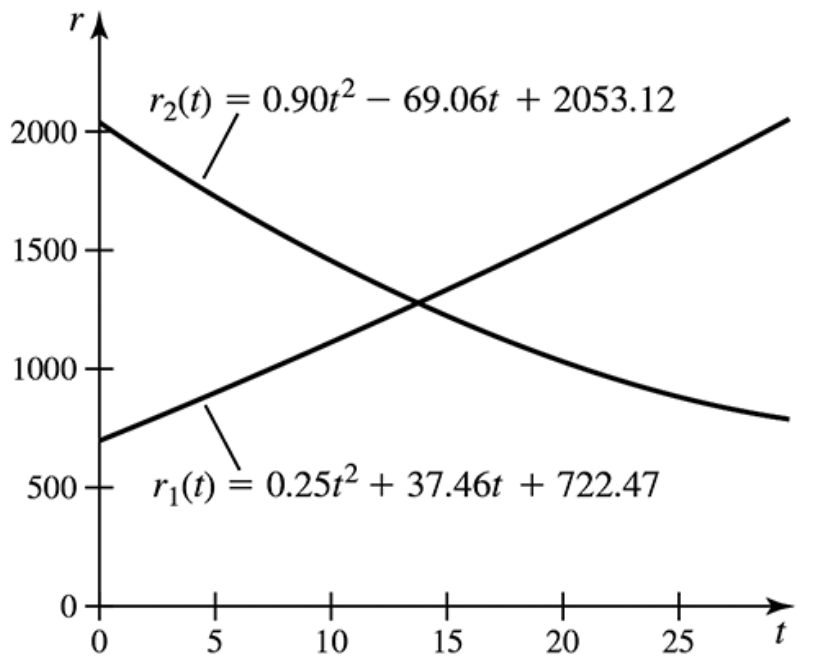
Flow rates in the Spokane River The daily discharge of the Spokane River as it flows through Spokane, Washington, in April and June is modeled by the functions
r1(t) = 0.25t²+37.46t+722.47 (April) and
r2(t) = 0.90t²−69.06t+2053.12 (June), where the discharge is measured in millions of cubic feet per day, and t=0 corresponds to the beginning of the first day of the month (see figure).
img
c. The Spokane River flows out of Lake Coeur d’Alene, which contains approximately 0.67mi³ of water. Determine the percentage of Lake Coeur d’Alene’s volume that flows through Spokane in April and June.

Verified step by step guidance
1
Identify the discharge functions for April and June: April is given by \(r_1(t) = 0.25t^{2} + 37.46t + 722.47\) and June by \(r_2(t) = 0.90t^{2} - 69.06t + 2053.12\), where \(t\) is in days and \(r(t)\) is in millions of cubic feet per day.
Calculate the total volume of water discharged in each month by integrating the discharge functions over the time interval from \(t=0\) to \(t=30\) (assuming 30 days in April and June). This means computing the definite integrals: \(V_1 = \int_0^{30} r_1(t) \, dt\) for April and \(V_2 = \int_0^{30} r_2(t) \, dt\) for June.
Convert the volume of water discharged from millions of cubic feet to cubic miles to be consistent with the volume of Lake Coeur d’Alene. Use the conversion factor: 1 cubic mile = 147,197,952,000 cubic feet. Since the discharge is in millions of cubic feet, multiply by \$10^6$ before converting.
Calculate the percentage of the lake's volume that flows through Spokane by dividing the volume discharged in each month by the total volume of the lake (0.67 cubic miles) and then multiplying by 100. That is, for April: \(\text{Percentage}_1 = \frac{V_1}{0.67} \times 100\) and for June: \(\text{Percentage}_2 = \frac{V_2}{0.67} \times 100\).
Interpret the results to understand how much of the lake's water volume passes through Spokane in each month, which provides insight into the river's flow relative to the lake's capacity.

Verified video answer for a similar problem:

This video solution was recommended by our tutors as helpful for the problem above.
Video duration:
6m
Was this helpful?

Key Concepts

Here are the essential concepts you must grasp in order to answer the question correctly.

Definite Integral as Accumulated Quantity

The definite integral of a rate function over a time interval represents the total accumulated quantity during that period. In this problem, integrating the discharge rate functions r1(t) and r2(t) over the days in April and June gives the total volume of water flowing through the river in those months.
Recommended video:
Guided course
05:43
Definition of the Definite Integral

Unit Conversion and Volume Comparison

To compare the total volume of water discharged with the volume of Lake Coeur d’Alene, it is essential to convert units consistently. The river discharge is given in millions of cubic feet per day, while the lake volume is in cubic miles. Converting cubic miles to cubic feet allows for a meaningful percentage comparison.
Recommended video:
04:48
Finding Volume Using Disks

Quadratic Functions and Their Graphs

The discharge rates are modeled by quadratic functions, which describe how the flow changes over time. Understanding the shape and behavior of these parabolas helps interpret the flow trends and ensures correct integration limits and calculations for total discharge.
Recommended video:
Guided course
5:53
Graph of Sine and Cosine Function
Related Practice
Textbook Question

A nonlinear spring Hooke’s law is applicable to idealized (linear) springs that are not stretched or compressed too far from their equilibrium positions. Consider a nonlinear spring whose restoring force is given by F(x) = 16x−0.1x³, for |x|≤7. 

c. How much work is done in compressing the spring from its equilibrium position (x=0) to x=−2?

89
views
Textbook Question

Determine whether the following statements are true and give an explanation or counterexample. 


c. Let f(x)=12x^2. The area of the surface generated when the graph of f on [−4, 4] is revolved about the x-axis is twice the area of the surface generated when the graph of f on [0, 4] is revolved about the x-axis. 

65
views
Textbook Question

Let R be the region in the first quadrant bounded above by the curve y=2−x² and bounded below by the line y=x. Suppose the shell method is used to determine the volume of the solid generated by revolving R about the y-axis.

c. Write an integral for the volume of the solid using the shell method.

59
views
Textbook Question

Probe speed A data collection probe is dropped from a stationary balloon, and it falls with a velocity (in m/s) given by v(t) = 9.8t, neglecting air resistance. After 10 s, a chute deploys and the probe immediately slows to a constant speed of 10 m/s, which it maintains until it enters the ocean.


c. If the probe was released from an altitude of 3 km, when does it enter the ocean?

46
views
Textbook Question

Explain why or why not Determine whether the following statements are true and give an explanation or counterexample.


Arc length may be negative if f(x) < 0 on part of the interval in question.

72
views
Textbook Question

Determine whether the following statements are true and give an explanation or counterexample.


c. ∫₀¹(x−x^2) dx=∫₀¹(√y−y) dy

54
views