
Position, displacement, and distance A projectile is launched vertically from the ground at t=0, and its velocity in flight (in m/s) is given by v(t)=20−10t. Find the position, displacement, and distance traveled after t seconds, for 0≤t≤4.
Table of contents
- 0. Functions7h 54m
- Introduction to Functions16m
- Piecewise Functions10m
- Properties of Functions9m
- Common Functions1h 8m
- Transformations5m
- Combining Functions27m
- Exponent rules32m
- Exponential Functions28m
- Logarithmic Functions24m
- Properties of Logarithms36m
- Exponential & Logarithmic Equations35m
- Introduction to Trigonometric Functions38m
- Graphs of Trigonometric Functions44m
- Trigonometric Identities47m
- Inverse Trigonometric Functions48m
- 1. Limits and Continuity2h 2m
- 2. Intro to Derivatives1h 33m
- 3. Techniques of Differentiation3h 18m
- 4. Applications of Derivatives2h 38m
- 5. Graphical Applications of Derivatives6h 2m
- 6. Derivatives of Inverse, Exponential, & Logarithmic Functions2h 37m
- 7. Antiderivatives & Indefinite Integrals1h 26m
- 8. Definite Integrals4h 44m
- 9. Graphical Applications of Integrals2h 27m
- 10. Physics Applications of Integrals 3h 16m
- 11. Integrals of Inverse, Exponential, & Logarithmic Functions2h 34m
- 12. Techniques of Integration7h 41m
- 13. Intro to Differential Equations2h 55m
- 14. Sequences & Series5h 36m
- 15. Power Series2h 19m
- 16. Parametric Equations & Polar Coordinates7h 58m
10. Physics Applications of Integrals
Kinematics
Problem 6.RE.9a
Textbook Question
Fuel consumption A small plane in flight consumes fuel at a rate (in gal/min) given by
R'(t) ={ 4t^{1/3} if 0 ≤ t ≤ 8 (take-off)
2 if t> 0 (cruising)
a. Find a function R that gives the total fuel consumed, for 0≤t≤8.
Verified step by step guidance1
Identify the given rate of fuel consumption function for the time interval 0 \leq t \leq 8, which is R'(t) = 4t^{1/3}. This represents the rate of fuel consumption in gallons per minute during take-off.
Recall that to find the total fuel consumed function R(t), you need to integrate the rate function R'(t) with respect to time t over the interval from 0 to t.
Set up the integral: R(t) = \int 4t^{1/3} \, dt. This integral will give the total fuel consumed from time 0 up to time t during take-off.
Perform the integration by applying the power rule for integrals: \int t^{n} \, dt = \frac{t^{n+1}}{n+1} + C. Here, n = \frac{1}{3}, so integrate accordingly and include the constant of integration C.
Use the initial condition R(0) = 0 (since no fuel is consumed at time zero) to solve for the constant C, ensuring the total fuel consumed function R(t) correctly models the situation.
Verified video answer for a similar problem:This video solution was recommended by our tutors as helpful for the problem above
Video duration:
2mPlay a video:
Was this helpful?
Key Concepts
Here are the essential concepts you must grasp in order to answer the question correctly.
Rate of Change and Derivatives
The rate of change represents how a quantity changes over time, often expressed as a derivative. In this problem, R'(t) is the rate of fuel consumption, showing how many gallons are used per minute at time t. Understanding derivatives helps interpret and work with rates in real-world contexts.
Recommended video:
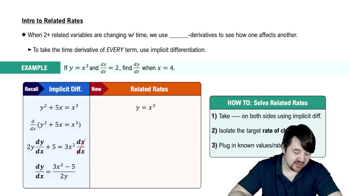
Intro To Related Rates
Integration to Find Accumulated Quantity
Integration is the reverse process of differentiation and is used to find the total accumulated amount from a rate function. Here, integrating R'(t) over time gives the total fuel consumed, R(t), between 0 and 8 minutes. This concept connects rates to total quantities.
Recommended video:
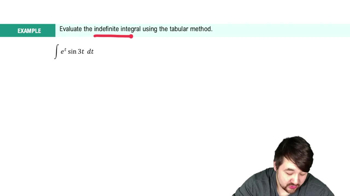
Tabular Integration by Parts Example 6
Piecewise Functions
Piecewise functions define different expressions over different intervals. The fuel consumption rate R'(t) changes form at t=8, requiring careful handling of each interval separately. Understanding piecewise functions ensures correct application of integration and interpretation of the problem.
Recommended video:
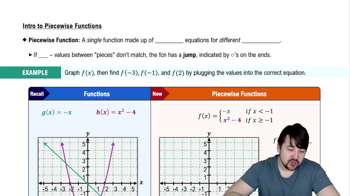
Piecewise Functions
Watch next
Master Using The Velocity Function with a bite sized video explanation from Patrick
Start learningRelated Videos
Related Practice
Textbook Question
6
views
