
a. Use the definition of a Taylor series to find the first four nonzero terms of the Taylor series for the given function centered at a.
f(x) = 2ˣ, a = 1
Verified step by step guidance
1
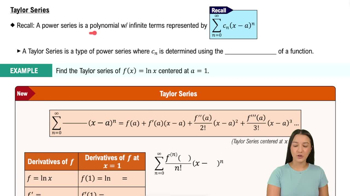
Recall the definition of the Taylor series of a function \(f(x)\) centered at \(a\):
\[f(x) = \sum_{n=0}^{\infty} \frac{f^{(n)}(a)}{n!} (x - a)^n,\]
where \(f^{(n)}(a)\) is the \(n\)-th derivative of \(f\) evaluated at \(x = a\).
Identify the function and the center: here, \(f(x) = 2^x\) and \(a = 1\). We will need to find the derivatives of \(f(x)\) and evaluate them at \(x=1\).
Find the first four derivatives of \(f(x)\):
- \(f(x) = 2^x\)
- \(f'(x) = 2^x \ln(2)\)
- \(f''(x) = 2^x (\ln(2))^2\)
- \(f^{(3)}(x) = 2^x (\ln(2))^3\)
- \(f^{(4)}(x) = 2^x (\ln(2))^4\)
Write the first four nonzero terms of the Taylor series using the formula:
\[f(x) \approx \sum_{n=0}^3 \frac{f^{(n)}(1)}{n!} (x - 1)^n = \sum_{n=0}^3 \frac{2 \cdot (\ln(2))^n}{n!} (x - 1)^n,\]
which explicitly is:
\[2 + 2 \ln(2)(x-1) + \frac{2 (\ln(2))^2}{2!} (x-1)^2 + \frac{2 (\ln(2))^3}{3!} (x-1)^3.\]
Verified video answer for a similar problem:
This video solution was recommended by our tutors as helpful for the problem above
Video duration:
2m
Play a video:
Was this helpful?
Key Concepts
Here are the essential concepts you must grasp in order to answer the question correctly.
Taylor Series Definition
A Taylor series represents a function as an infinite sum of terms calculated from the derivatives of the function at a single point. Each term involves the nth derivative evaluated at the center point, multiplied by (x - a)^n and divided by n!. This series approximates the function near the center a.
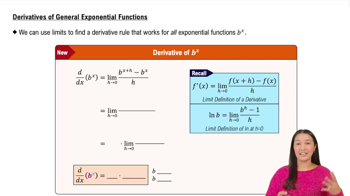
For the function f(x) = 2^x, derivatives involve the natural logarithm of the base. Specifically, the nth derivative of 2^x is (ln 2)^n times 2^x. Understanding this pattern is essential to compute the terms of the Taylor series accurately.
To find the Taylor series terms centered at a = 1, each derivative must be evaluated at x = 1. These values are then used in the formula for each term, ensuring the series accurately approximates the function near x = 1.