
Textbook Question
Make up an infinite series of nonzero terms whose sum is
b. −3
17
views

 Verified step by step guidance
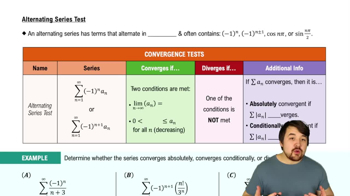
 10:54
10:54
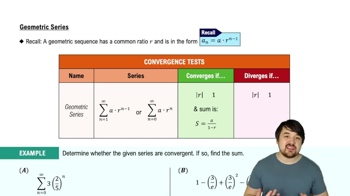 06:00
06:00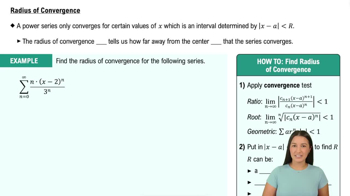 07:36
07:36Make up an infinite series of nonzero terms whose sum is
b. −3
In Exercises 15–22, determine if the geometric series converges or diverges. If a series converges, find its sum.
1 − (2/e) + (2/e)² − (2/e)³ + (2/e)⁴ − …
In Exercises 57–82, use any method to determine whether the series converges or diverges. Give reasons for your answer.
∑ (from n = 1 to ∞) [3ⁿ / n³]
Limit Comparison Test
In Exercises 9–16, use the Limit Comparison Test to determine if each series converges or diverges.
∑ (from n=2 to ∞) 1 / ln n
(Hint: Limit Comparison with ∑ (from n=2 to ∞) (1/n))
Applying the Integral Test
Use the Integral Test to determine if the series in Exercises 1–12 converge or diverge. Be sure to check that the conditions of the Integral Test are satisfied.
∑ (from n = 2 to ∞) ln(n²) / n
Telescoping Series
In Exercises 39–44, find a formula for the nth partial sum of the series and use it to determine if the series converges or diverges. If a series converges, find its sum.
∑ (from n = 1 to ∞) [ (1/n) − (1/(n + 1)) ]