Ch. 8 - Integration Techniques
Briggs - Calculus: Early Transcendentals 3rd Edition
Briggs3rd EditionCalculus: Early TranscendentalsISBN: 9780136847243Not the one you use?Change textbook
Chapter 8, Problem 8.4.68

60–69. Completing the square Evaluate the following integrals.
68. ∫ dx / sqrt((x - 1)(3 - x))

Verified step by step guidance
1
Step 1: Recognize that the integral involves a square root in the denominator, specifically sqrt((x - 1)(3 - x)). This suggests that completing the square or trigonometric substitution might be useful.
Step 2: Rewrite the expression (x - 1)(3 - x) in a more convenient form. Factor it as -(x^2 - 4x + 3). Then complete the square for the quadratic expression inside the parentheses: x^2 - 4x + 3 = (x - 2)^2 - 1.
Step 3: Substitute the completed square form back into the integral. The denominator becomes sqrt(-((x - 2)^2 - 1)), which simplifies to sqrt(1 - (x - 2)^2). This suggests a trigonometric substitution.
Step 4: Use the substitution x - 2 = sin(θ), which implies dx = cos(θ)dθ and simplifies the square root to sqrt(1 - sin^2(θ)) = cos(θ). Substitute these into the integral.
Step 5: After substitution, the integral becomes ∫ dθ, which is straightforward to evaluate. Once the integral is solved, back-substitute to return to the original variable x.

Verified video answer for a similar problem:

This video solution was recommended by our tutors as helpful for the problem above.
Video duration:
2m
Was this helpful?

Key Concepts

Here are the essential concepts you must grasp in order to answer the question correctly.

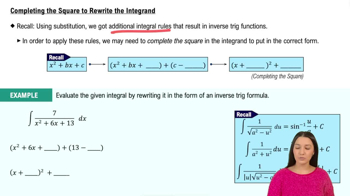
Completing the Square

Completing the square is a method used to transform a quadratic expression into a perfect square trinomial. This technique is essential for simplifying integrals involving square roots of quadratic expressions, allowing for easier integration. By rewriting the expression in the form (x - h)² - k, we can identify the vertex and facilitate the integration process.
Recommended video:
05:22
Completing the Square to Rewrite the Integrand

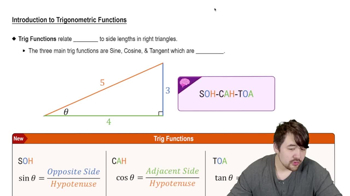
Trigonometric Substitution

Trigonometric substitution is a technique used in calculus to simplify integrals involving square roots. By substituting a variable with a trigonometric function, such as x = a sin(θ) or x = a cos(θ), we can transform the integral into a more manageable form. This method is particularly useful for integrals that involve expressions like √(a² - x²) or √(x² - a²).
Recommended video:
6:04
Introduction to Trigonometric Functions

Definite and Indefinite Integrals

Integrals can be classified as definite or indefinite. An indefinite integral represents a family of functions and includes a constant of integration, while a definite integral calculates the area under a curve between two specific limits. Understanding the distinction is crucial for evaluating integrals correctly, especially when applying techniques like substitution or completing the square.
Recommended video:
05:43
Definition of the Definite Integral