A researcher is comparing average number of hours spelt per night by college students who work part-time versus those who don't. From survey data, they calculate hours and hours with a margin of error of 0.41. Should they reject or fail to reject the claim that there is no difference in hours slept between the two groups?
Table of contents
- 1. Introduction to Statistics53m
- 2. Describing Data with Tables and Graphs2h 1m
- 3. Describing Data Numerically2h 8m
- 4. Probability2h 26m
- 5. Binomial Distribution & Discrete Random Variables3h 28m
- 6. Normal Distribution & Continuous Random Variables2h 21m
- 7. Sampling Distributions & Confidence Intervals: Mean3h 37m
- Sampling Distribution of the Sample Mean and Central Limit Theorem19m
- Distribution of Sample Mean - Excel23m
- Introduction to Confidence Intervals22m
- Confidence Intervals for Population Mean1h 26m
- Determining the Minimum Sample Size Required12m
- Finding Probabilities and T Critical Values - Excel28m
- Confidence Intervals for Population Means - Excel25m
- 8. Sampling Distributions & Confidence Intervals: Proportion1h 33m
- 9. Hypothesis Testing for One Sample3h 32m
- 10. Hypothesis Testing for Two Samples4h 49m
- Two Proportions1h 12m
- Two Proportions Hypothesis Test - Excel28m
- Two Means - Unknown, Unequal Variance1h 2m
- Two Means - Unknown Variances Hypothesis Test - Excel12m
- Two Means - Unknown, Equal Variance15m
- Two Means - Unknown, Equal Variances Hypothesis Test - Excel9m
- Two Means - Known Variance12m
- Two Means - Sigma Known Hypothesis Test - Excel21m
- Two Means - Matched Pairs (Dependent Samples)42m
- Matched Pairs Hypothesis Test - Excel12m
- 11. Correlation1h 24m
- 12. Regression1h 59m
- 13. Chi-Square Tests & Goodness of Fit2h 31m
- 14. ANOVA2h 1m
10. Hypothesis Testing for Two Samples
Two Means - Unknown, Unequal Variance
Struggling with Statistics for Business?
Join thousands of students who trust us to help them ace their exams!Watch the first videoMultiple Choice
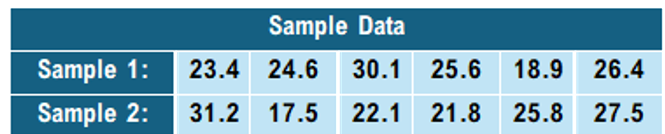
Create a confidence interval with for the difference between the 2 population means to see if there's evidence that .

A
Confidence interval = (−4.02,5.06); includes 0, not enough evidence to suggest μ1=μ2.
B
Confidence interval = (−4.02,5.06); enough evidence to suggest μ1=μ2.
C
Confidence interval = (4.02,5.06); not enough evidence to suggest μ1=μ2.
D
Confidence interval = (4.02,5.06); enough evidence to suggest μ1=μ2.
Verified step by step guidance1
Calculate the sample means (\( \bar{x}_1 \) and \( \bar{x}_2 \)) for Sample 1 and Sample 2 by summing the values in each sample and dividing by the number of observations (7 in each sample).
Calculate the sample standard deviations (\( s_1 \) and \( s_2 \)) for each sample using the formula for sample standard deviation: \( s = \sqrt{\frac{\sum (x_i - \bar{x})^2}{n-1}} \), where \( n \) is the sample size.
Determine the standard error (SE) of the difference between the two sample means using the formula: \[ SE = \sqrt{\frac{s_1^2}{n_1} + \frac{s_2^2}{n_2}} \], where \( n_1 \) and \( n_2 \) are the sample sizes.
Find the critical t-value (\( t_{\alpha/2} \)) for a two-tailed test with \( \alpha = 0.1 \) and degrees of freedom approximated using the smaller of \( n_1 - 1 \) and \( n_2 - 1 \) or using the Welch-Satterthwaite equation for unequal variances.
Construct the confidence interval for the difference between the population means using the formula: \[ (\bar{x}_1 - \bar{x}_2) \pm t_{\alpha/2} \times SE \]. This interval will help determine if zero is included, indicating whether there is evidence that \( \mu_1 \neq \mu_2 \).
Watch next
Master Difference in Means: Hypothesis Tests with a bite sized video explanation from Patrick
Start learningRelated Videos
Related Practice
Multiple Choice
Two Means - Unknown, Unequal Variance practice set

