
a. Identify the function’s local extreme values in the given domain, and say where they occur.
g(x) = −x² − 6x − 9,−4 ≤ x < ∞
Verified step by step guidance
1
To find the local extrema of the function \( g(x) = -x^2 - 6x - 9 \), we first need to find its derivative. The derivative \( g'(x) \) will help us identify critical points where the slope of the tangent is zero or undefined.
Calculate the derivative of \( g(x) \). Using the power rule, the derivative is \( g'(x) = -2x - 6 \).
Set the derivative equal to zero to find the critical points: \( -2x - 6 = 0 \). Solve for \( x \) to find the critical point.
Once the critical point is found, determine whether it is a local maximum or minimum by using the second derivative test. Calculate the second derivative \( g''(x) \) and evaluate it at the critical point.
Finally, check the endpoints of the domain \( -4 \leq x < \infty \) to ensure there are no other local extrema. Since the domain is unbounded on the right, focus on the behavior of the function as \( x \to -4 \) and as \( x \to \, \infty \).
Verified video answer for a similar problem:
This video solution was recommended by our tutors as helpful for the problem above
Video duration:
3m
Play a video:
0 Comments
Key Concepts
Here are the essential concepts you must grasp in order to answer the question correctly.
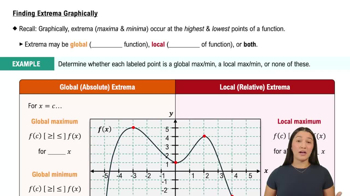
Local Extrema
Local extrema refer to the points in a function where it reaches a local maximum or minimum within a specific interval. These are points where the function changes direction, and can be identified by finding where the derivative equals zero or is undefined. Understanding local extrema is crucial for analyzing the behavior of functions within a given domain.
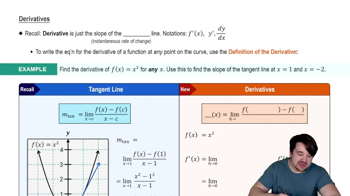
The derivative of a function represents the rate of change of the function's value with respect to its input. It is a fundamental tool in calculus for finding slopes of tangent lines and identifying critical points, which are potential locations for local extrema. Calculating the derivative of g(x) helps determine where the function's slope is zero, indicating possible extrema.
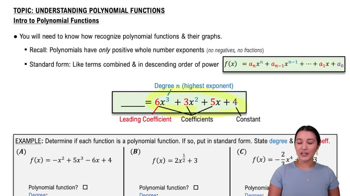
Quadratic functions are polynomial functions of degree two, typically in the form ax² + bx + c. They graph as parabolas, which can open upwards or downwards. The vertex of the parabola represents the function's maximum or minimum value, depending on the direction it opens. For g(x) = −x² − 6x − 9, understanding its quadratic nature helps identify the vertex as the point of local extremum.