

Ch. 4 - Applications of Derivatives
Hass - Thomas' Calculus 15th Edition
Hass15th EditionThomas' CalculusISBN: 9780137616077Not the one you use?Change textbook
Chapter 4, Problem 4.2.20

Roots (Zeros)


Show that the functions in Exercises 19–26 have exactly one zero in the given interval.


f(x) = x³ + 4x² + 7, (−∞, 0)

Verified step by step guidance
1
First, understand that finding the zero of a function means finding the value of x for which f(x) = 0. We need to show that the function f(x) = x³ + 4x² + 7 has exactly one zero in the interval (-∞, 0).
To begin, evaluate the function at the endpoints of the interval. Since the interval is (-∞, 0), consider the behavior of the function as x approaches 0 from the left and as x approaches negative infinity.
Next, calculate the derivative of the function, f'(x) = 3x² + 8x, to analyze the behavior of the function. This will help determine if the function is increasing or decreasing in the interval.
Examine the sign of f'(x) in the interval (-∞, 0). If f'(x) is negative throughout the interval, the function is strictly decreasing, which implies that it can have at most one zero.
Finally, use the Intermediate Value Theorem. Since f(x) is continuous and changes sign in the interval (for example, f(x) is positive at x = 0 and negative as x approaches negative infinity), there must be at least one zero in the interval. Combine this with the previous step to conclude that there is exactly one zero.

Verified video answer for a similar problem:

This video solution was recommended by our tutors as helpful for the problem above.
Video duration:
4m
Was this helpful?

Key Concepts

Here are the essential concepts you must grasp in order to answer the question correctly.

Intermediate Value Theorem

The Intermediate Value Theorem states that for any continuous function f(x) on a closed interval [a, b], if f(a) and f(b) have opposite signs, then there exists at least one c in (a, b) such that f(c) = 0. This theorem is crucial for proving the existence of a zero in a given interval.
Recommended video:
06:11
Fundamental Theorem of Calculus Part 1

Continuity of Polynomial Functions

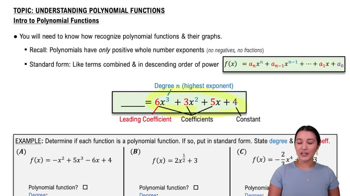
Polynomial functions, such as f(x) = x³ + 4x² + 7, are continuous everywhere on the real number line. This property ensures that the function does not have any breaks, jumps, or holes, which is essential when applying the Intermediate Value Theorem to find zeros.
Recommended video:
6:04
Introduction to Polynomial Functions

Behavior of Polynomial Functions at Infinity

Understanding the behavior of polynomial functions as x approaches infinity or negative infinity helps determine the number of zeros. For f(x) = x³ + 4x² + 7, as x approaches negative infinity, the dominant term x³ dictates that f(x) approaches negative infinity, indicating a sign change in the interval (−∞, 0).
Recommended video:
6:04
Introduction to Polynomial Functions