Use the linear approximation (1 + x)ᵏ ≈ 1 + kx to find an approximation for the function f(x) for values of x near zero.
a. f(x) = (1 − x)⁶
Verified step by step guidance
1
Identify the function f(x) = (1 - x)⁶ and recognize that it is in the form of (1 + x)ᵏ with k = 6 and x replaced by -x.
Apply the linear approximation formula (1 + x)ᵏ ≈ 1 + kx to the function. Here, substitute x with -x and k with 6.
The linear approximation becomes: (1 - x)⁶ ≈ 1 + 6(-x).
Simplify the expression: 1 + 6(-x) becomes 1 - 6x.
Thus, the linear approximation for f(x) = (1 - x)⁶ near x = 0 is f(x) ≈ 1 - 6x.
Verified video answer for a similar problem:
This video solution was recommended by our tutors as helpful for the problem above
Video duration:
1m
Play a video:
0 Comments
Key Concepts
Here are the essential concepts you must grasp in order to answer the question correctly.
Linear Approximation
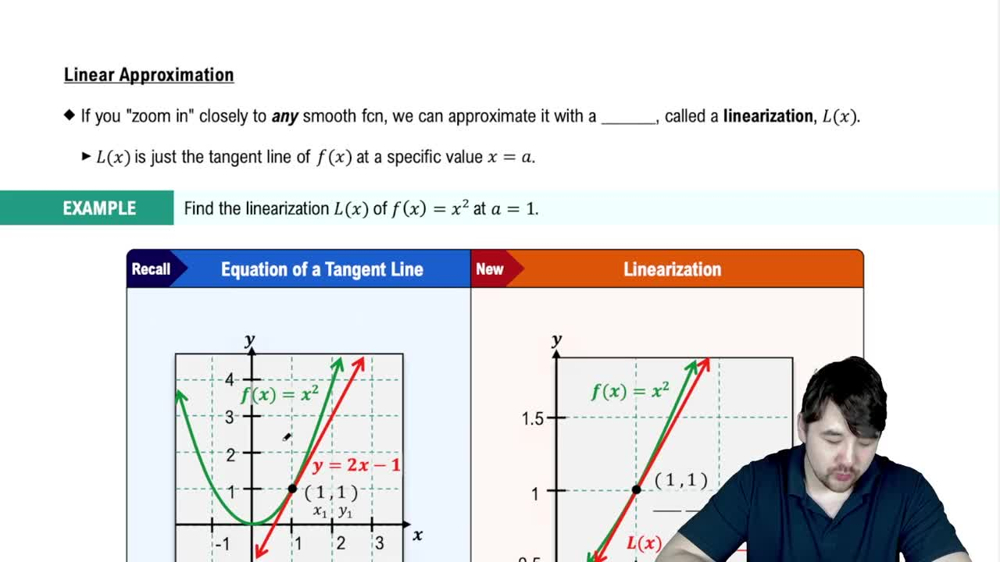
Linear approximation is a method used to estimate the value of a function near a given point using the tangent line at that point. For a function f(x), the linear approximation at x = a is given by f(a) + f'(a)(x - a). This technique is particularly useful for simplifying complex functions near a specific point, often x = 0.
The binomial expansion is a way of expressing powers of binomials, such as (1 + x)ᵏ, as a series. For small values of x, the expansion can be approximated by the first few terms, often just 1 + kx for linear approximation. This simplification is useful for estimating the behavior of functions like (1 - x)⁶ near x = 0.
Understanding the behavior of functions near zero involves analyzing how the function changes as x approaches zero. This often involves using approximations or expansions to simplify the function, making it easier to evaluate or estimate. For f(x) = (1 - x)⁶, using linear approximation helps predict its value when x is close to zero.

 1:43 minutes
 Verified step by step guidance
 07:17
07:17