

Ch. 4 - Applications of Derivatives
Hass - Thomas' Calculus 15th Edition
Hass15th EditionThomas' CalculusISBN: 9780137616077Not the one you use?Change textbook
Chapter 4, Problem 4.3.59a

Identifying Extrema


In Exercises 53–60:


a. Find the local extrema of each function on the given interval, and say where they occur.


f(x) = csc²x − 2cot x, 0 < x < π

Verified step by step guidance
1
To find the local extrema of the function \( f(x) = \csc^2 x - 2 \cot x \) on the interval \( 0 < x < \pi \), we first need to find the derivative \( f'(x) \).
Recall that \( \csc x = \frac{1}{\sin x} \) and \( \cot x = \frac{\cos x}{\sin x} \). Use the chain rule and quotient rule to differentiate \( \csc^2 x \) and \( \cot x \).
The derivative of \( \csc^2 x \) is \( -2 \csc^2 x \cot x \), and the derivative of \( -2 \cot x \) is \( 2 \csc^2 x \). Therefore, \( f'(x) = -2 \csc^2 x \cot x + 2 \csc^2 x \).
Set \( f'(x) = 0 \) to find critical points: \( -2 \csc^2 x \cot x + 2 \csc^2 x = 0 \). Simplify to find \( \cot x = 1 \).
Solve \( \cot x = 1 \) within the interval \( 0 < x < \pi \) to find the critical points. Evaluate \( f(x) \) at these critical points to determine the local extrema.

Verified video answer for a similar problem:

This video solution was recommended by our tutors as helpful for the problem above.
Video duration:
6m
Was this helpful?

Key Concepts

Here are the essential concepts you must grasp in order to answer the question correctly.

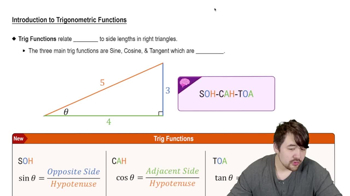
Trigonometric Functions

Understanding the trigonometric functions involved, such as cosecant (csc) and cotangent (cot), is crucial. The cosecant function is the reciprocal of sine, and cotangent is the reciprocal of tangent. These functions have specific properties and behaviors, especially within the interval 0 < x < π, which affect the function's behavior and the location of extrema.
Recommended video:
6:04
Introduction to Trigonometric Functions

Derivatives and Critical Points

To find local extrema, we need to calculate the derivative of the function and identify critical points where the derivative is zero or undefined. These points are potential candidates for local maxima or minima. Analyzing the derivative helps determine the function's increasing or decreasing behavior, which is essential for locating extrema.
Recommended video:
04:50
Critical Points

Interval Analysis

The given interval, 0 < x < π, restricts the domain of the function, affecting where extrema can occur. It's important to consider the behavior of the function at the boundaries and within this interval. Since trigonometric functions can have discontinuities or undefined points, careful analysis within the specified range is necessary to accurately identify local extrema.
Recommended video:
02:59
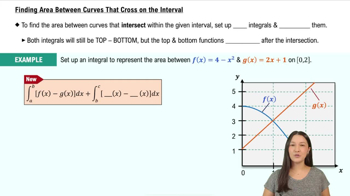
Finding Area Between Curves that Cross on the Interval
Related Practice
Textbook Question

51. Frictionless cart A small frictionless cart, attached to the wall by a spring, is pulled 10 cm from its rest position and released at time t = 0 to roll back and forth for 4 sec. Its position at time t is s = 10 cos πt.

a. What is the cart's maximum speed? When is the cart moving that fast? Where is it then? What is the magnitude of the acceleration then?

204
views
Textbook Question

Identifying Extrema


In Exercises 53–60:


a. Find the local extrema of each function on the given interval, and say where they occur.


f(x) = sec²x − 2tan x, −π/2 < x < π/2

220
views
Textbook Question

Identifying Extrema


In Exercises 41–52:


a. Identify the function’s local extreme values in the given domain, and say where they occur.


f(x) = (x + 1)², −∞ < x ≤ 0

156
views
Textbook Question

Identifying Extrema


In Exercises 19–40:


a. Find the open intervals on which the function is increasing and those on which it is decreasing.


f(r) = 3r³ + 16r

178
views
Textbook Question

Identifying Extrema


In Exercises 41–52:


a. Identify the function’s local extreme values in the given domain, and say where they occur.


f(x) = √(x² − 2x − 3), 3 ≤ x < ∞

152
views
Textbook Question

25. Paper folding A rectangular sheet of 8.5-in.-by-11-in. paper is placed on a flat surface. One of the corners is placed on the opposite longer edge, as shown in the figure, and held there as the paper is smoothed flat. The problem is to make the length of the crease as small as possible. Call the length L. Try it with paper.

" style="" width="370">

a. Show that L^2=2x^3/(2x-8.5).

354
views