Compare the given equation \( \sin^2 \theta + \cos^2 \theta = 2 \) with the Pythagorean identity.
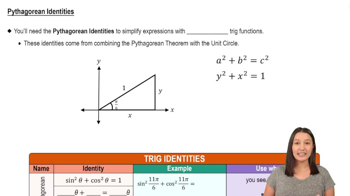
Understand that the Pythagorean identity holds for all angles \( \theta \), meaning \( \sin^2 \theta + \cos^2 \theta \) always equals 1.
Since the given equation states that \( \sin^2 \theta + \cos^2 \theta = 2 \), which contradicts the identity, evaluate the possibility of this statement.
Conclude whether the statement \( \sin^2 \theta + \cos^2 \theta = 2 \) is possible or impossible based on the Pythagorean identity.
Verified video answer for a similar problem:
This video solution was recommended by our tutors as helpful for the problem above
Video duration:
54s
Play a video:
0 Comments
Key Concepts
Here are the essential concepts you must grasp in order to answer the question correctly.
Pythagorean Identity
The Pythagorean identity states that for any angle θ, the sum of the squares of the sine and cosine functions equals one: sin² θ + cos² θ = 1. This fundamental identity is crucial in trigonometry and serves as a basis for many other trigonometric equations and transformations.
The sine and cosine functions have a range of values between -1 and 1. This means that the maximum value of sin² θ and cos² θ is 1, making the maximum possible value of sin² θ + cos² θ equal to 2 only if both functions equal 1 simultaneously, which is impossible for any angle θ.
Trigonometric functions take specific values at certain angles. For example, sin(90°) = 1 and cos(90°) = 0. However, there is no angle θ for which both sin² θ and cos² θ can equal 1 at the same time, reinforcing that the equation sin² θ + cos² θ = 2 is impossible.

 0:54 minutes
 Verified step by step guidance
 6:25
6:25