Table of contents
- 1. Introduction to Statistics53m
- 2. Describing Data with Tables and Graphs2h 1m
- 3. Describing Data Numerically2h 8m
- 4. Probability2h 26m
- 5. Binomial Distribution & Discrete Random Variables3h 28m
- 6. Normal Distribution & Continuous Random Variables2h 21m
- 7. Sampling Distributions & Confidence Intervals: Mean3h 37m
- Sampling Distribution of the Sample Mean and Central Limit Theorem19m
- Distribution of Sample Mean - Excel23m
- Introduction to Confidence Intervals22m
- Confidence Intervals for Population Mean1h 26m
- Determining the Minimum Sample Size Required12m
- Finding Probabilities and T Critical Values - Excel28m
- Confidence Intervals for Population Means - Excel25m
- 8. Sampling Distributions & Confidence Intervals: Proportion1h 33m
- 9. Hypothesis Testing for One Sample3h 32m
- 10. Hypothesis Testing for Two Samples4h 49m
- Two Proportions1h 12m
- Two Proportions Hypothesis Test - Excel28m
- Two Means - Unknown, Unequal Variance1h 2m
- Two Means - Unknown Variances Hypothesis Test - Excel12m
- Two Means - Unknown, Equal Variance15m
- Two Means - Unknown, Equal Variances Hypothesis Test - Excel9m
- Two Means - Known Variance12m
- Two Means - Sigma Known Hypothesis Test - Excel21m
- Two Means - Matched Pairs (Dependent Samples)42m
- Matched Pairs Hypothesis Test - Excel12m
- 11. Correlation1h 24m
- 12. Regression1h 59m
- 13. Chi-Square Tests & Goodness of Fit2h 31m
- 14. ANOVA2h 1m
2. Describing Data with Tables and Graphs
Histograms
Struggling with Statistics for Business?
Join thousands of students who trust us to help them ace their exams!Watch the first videoMultiple Choice
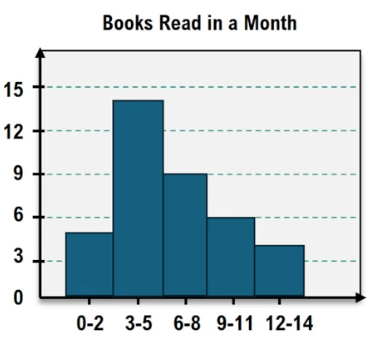
Use the frequency histogram below to determine (a) the number of classes and (b) the class width.
A
(a) 5 classes; (b) 2
B
(a) 5 classes; (b) 3
C
(a) 4 classes; (b) 3
D
(a) 14 classes; (b) 2
Verified step by step guidance1
Identify the number of classes by counting the distinct bars in the histogram. Each bar represents a class.
Count the number of bars in the histogram. In this case, there are 5 bars, indicating 5 classes.
Determine the class width by examining the range of each class. The class width is the difference between the upper and lower boundaries of a class.
Look at the first class, which ranges from 0 to 2. The class width is calculated as 2 - 0 = 2.
Verify the class width by checking other classes. For example, the second class ranges from 3 to 5, and the width is 5 - 3 = 2. This confirms the class width is consistent across all classes.
Related Videos
0

