Identify the function y = ((3t - 4) / (5t + 2))^(-5) and recognize that it is a composition of functions, which suggests the use of the chain rule for differentiation.
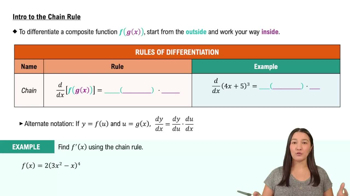
Apply the chain rule: If y = u^n, where u is a function of t, then dy/dt = n * u^(n-1) * du/dt. Here, u = (3t - 4) / (5t + 2) and n = -5.
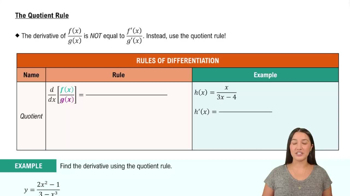
Differentiate u = (3t - 4) / (5t + 2) with respect to t using the quotient rule: If u = v/w, then du/dt = (w * dv/dt - v * dw/dt) / w^2. Here, v = 3t - 4 and w = 5t + 2.
Calculate dv/dt and dw/dt: dv/dt = 3 and dw/dt = 5. Substitute these into the quotient rule to find du/dt.
Substitute u, n, and du/dt into the chain rule expression to find dy/dt. Simplify the expression to complete the differentiation process.
Verified video answer for a similar problem:
This video solution was recommended by our tutors as helpful for the problem above
Video duration:
8m
Play a video:
Was this helpful?
Key Concepts
Here are the essential concepts you must grasp in order to answer the question correctly.
Chain Rule
The chain rule is a fundamental differentiation technique used when dealing with composite functions. It states that the derivative of a composite function f(g(x)) is f'(g(x)) * g'(x). In this problem, the chain rule helps differentiate the outer function raised to a power and the inner rational function separately.
The quotient rule is used to differentiate functions that are expressed as a quotient of two functions, u(t)/v(t). It states that the derivative is (v(t)u'(t) - u(t)v'(t)) / (v(t))². This rule is essential for finding the derivative of the inner function (3t - 4)/(5t + 2) in the given problem.
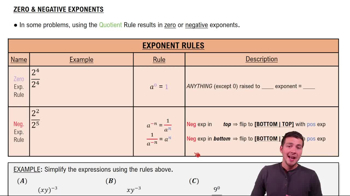
The negative exponent rule states that a term with a negative exponent can be rewritten as the reciprocal of the term with a positive exponent. In this problem, y = ((3t − 4) / (5t + 2))⁻⁵ implies that the function is the reciprocal of ((3t − 4) / (5t + 2)) raised to the fifth power, which affects how the derivative is calculated.