First, identify the function y = 4 sin(√(1 + √t)). We need to find dy/dt, which involves differentiating y with respect to t.
Notice that y is a composite function. It involves the sine function, a square root, and another square root inside. We will use the chain rule to differentiate it.
Start by differentiating the outer function: y = 4 sin(u), where u = √(1 + √t). The derivative of sin(u) with respect to u is cos(u). Therefore, dy/du = 4 cos(u).
Next, differentiate u = √(1 + √t) with respect to t. This requires using the chain rule again. Let v = 1 + √t, so u = √v. The derivative of √v with respect to v is 1/(2√v).
Finally, differentiate v = 1 + √t with respect to t. The derivative of √t with respect to t is 1/(2√t). Combine all these derivatives using the chain rule to find dy/dt.
Verified video answer for a similar problem:
This video solution was recommended by our tutors as helpful for the problem above
Video duration:
7m
Play a video:
0 Comments
Key Concepts
Here are the essential concepts you must grasp in order to answer the question correctly.
Chain Rule
The chain rule is a fundamental technique in calculus used to differentiate composite functions. It states that if a function y = f(g(x)) is composed of two functions, the derivative dy/dx is f'(g(x)) * g'(x). In this problem, the chain rule helps differentiate the nested functions within y = 4 sin(√(1 + √t)).
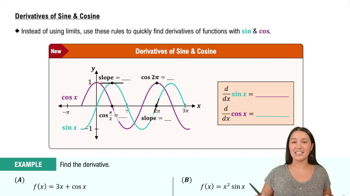
The derivative of the sine function is crucial for solving this problem. The derivative of sin(u) with respect to u is cos(u). When differentiating y = 4 sin(√(1 + √t)), this rule is applied to find the derivative of the sine component, which is part of the composite function.
Understanding how to differentiate square root functions is essential here. The derivative of √u with respect to u is 1/(2√u). This rule is applied twice in the problem: first to differentiate √t and then to differentiate √(1 + √t), which are nested within the sine function.