
Textbook Question
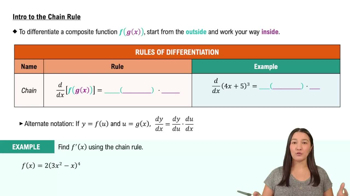
In Exercises 41–58, find dy/dt.
y = (t⁻³/⁴ sin(t))⁴/³
250
views

 Verified step by step guidance
 05:02
05:02
 6:04
6:04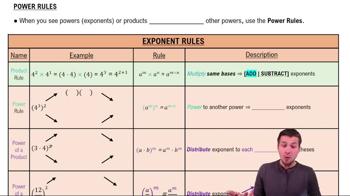 5:50
5:50In Exercises 41–58, find dy/dt.
y = (t⁻³/⁴ sin(t))⁴/³
In Exercises 83–88, find equations for the lines that are tangent, and the lines that are normal, to the curve at the given point.
(y - x)² = 2x + 4, (6, 2)
a. Graph the function
ƒ(x) = { x², -1 ≤ x < 0
{ -x², 0 ≤ x ≤ 1.
b. Is ƒ continuous at x = 0?
c. Is ƒ differentiable at x = 0?
Give reasons for your answers.
Find the points on the curve y = 2x³ - 3x² - 12x + 20 where the tangent line is
a. perpendicular to the line y = 1 - (x/24).
_
b. parallel to the line y = √2 - 12x.
Find the derivatives of the functions in Exercises 19–40.
s = (4 / 3π)sin(3t) + (4 / 5π)cos(5t)
Differential Estimates of Change
In Exercises 35–40, write a differential formula that estimates the given change in volume or surface area.
The change in the surface area S = 6x² of a cube when the edge lengths change from x₀ to x₀ + dx