Find the derivatives of the functions in Exercises 19–40.
y = (4x + 3)⁴(x + 1)⁻³
Verified step by step guidance
1
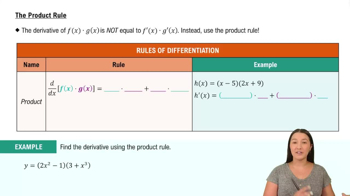
Identify the function as a product of two functions: \( u(x) = (4x + 3)^4 \) and \( v(x) = (x + 1)^{-3} \). We will use the product rule for differentiation, which states that if \( y = u(x) \cdot v(x) \), then \( y' = u'(x) \cdot v(x) + u(x) \cdot v'(x) \).
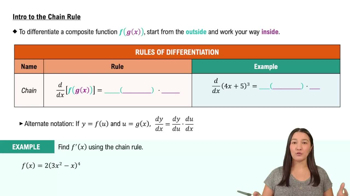
Differentiate \( u(x) = (4x + 3)^4 \) using the chain rule. Let \( z = 4x + 3 \), then \( u(x) = z^4 \). The derivative \( u'(x) = 4z^3 \cdot \frac{d}{dx}(4x + 3) \). Since \( \frac{d}{dx}(4x + 3) = 4 \), we have \( u'(x) = 16(4x + 3)^3 \).
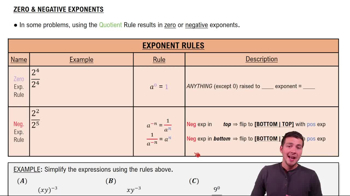
Differentiate \( v(x) = (x + 1)^{-3} \) using the power rule. The derivative \( v'(x) = -3(x + 1)^{-4} \cdot \frac{d}{dx}(x + 1) \). Since \( \frac{d}{dx}(x + 1) = 1 \), we have \( v'(x) = -3(x + 1)^{-4} \).
Simplify the expression: \( y' = 16(4x + 3)^3(x + 1)^{-3} - 3(4x + 3)^4(x + 1)^{-4} \). Factor and combine like terms if possible to simplify further.
Verified video answer for a similar problem:
This video solution was recommended by our tutors as helpful for the problem above
Video duration:
8m
Play a video:
Was this helpful?
Key Concepts
Here are the essential concepts you must grasp in order to answer the question correctly.
Product Rule
The product rule is a fundamental technique in calculus used to find the derivative of a product of two functions. If you have two functions, u(x) and v(x), the derivative of their product is given by u'(x)v(x) + u(x)v'(x). This rule is essential when differentiating expressions where two functions are multiplied together, as seen in the given problem.
The chain rule is a method for differentiating composite functions, where one function is nested inside another. If you have a function y = f(g(x)), the derivative is found by taking the derivative of the outer function f with respect to g, and then multiplying it by the derivative of the inner function g with respect to x. This rule is crucial for handling expressions with powers, such as (4x + 3)⁴ in the problem.
Negative exponents indicate reciprocal functions, and understanding how to differentiate them is important. For a function like (x + 1)⁻³, the derivative involves applying the power rule, which states that the derivative of xⁿ is n*xⁿ⁻¹, and then considering the negative exponent. This concept helps in simplifying and differentiating terms with negative powers in the given expression.