Find the derivatives of the functions in Exercises 19–40.
g(t) = (1 + sin(3t) / (3 − 2t))⁻¹
Verified step by step guidance
1
Identify the function type: The function g(t) = (1 + sin(3t) / (3 − 2t))⁻¹ is a composite function involving a reciprocal and a quotient. We will need to use the chain rule and the quotient rule to find its derivative.
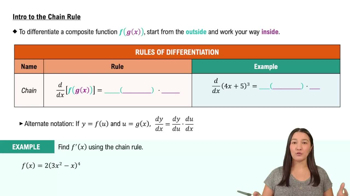
Apply the chain rule: Let u(t) = 1 + sin(3t) / (3 − 2t). Then g(t) = u(t)⁻¹. The derivative of g(t) with respect to t is -u(t)⁻² * u'(t), where u'(t) is the derivative of u(t).
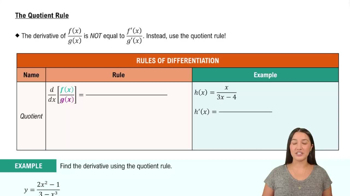
Find u'(t) using the quotient rule: For u(t) = 1 + sin(3t) / (3 − 2t), let f(t) = sin(3t) and h(t) = 3 − 2t. The quotient rule states that the derivative of f(t)/h(t) is (f'(t)h(t) - f(t)h'(t)) / h(t)².
Calculate f'(t) and h'(t): The derivative of f(t) = sin(3t) is f'(t) = 3cos(3t) using the chain rule. The derivative of h(t) = 3 − 2t is h'(t) = -2.
Substitute into the quotient rule: Substitute f'(t), f(t), h(t), and h'(t) into the quotient rule formula to find u'(t). Then substitute u(t) and u'(t) into the chain rule formula to find g'(t).
Verified video answer for a similar problem:
This video solution was recommended by our tutors as helpful for the problem above
Video duration:
7m
Play a video:
Was this helpful?
Key Concepts
Here are the essential concepts you must grasp in order to answer the question correctly.
Chain Rule
The chain rule is a fundamental technique in calculus used to differentiate composite functions. It states that if a function y = f(g(x)) is composed of two functions, the derivative is found by multiplying the derivative of the outer function by the derivative of the inner function. In this problem, the chain rule helps differentiate the outer function (1/u)⁻¹ with respect to the inner function u = (1 + sin(3t)) / (3 - 2t).
The quotient rule is used to differentiate functions that are ratios of two differentiable functions. If a function is given by u(t)/v(t), its derivative is (v(t)u'(t) - u(t)v'(t)) / (v(t))². In this problem, the quotient rule is applied to differentiate the inner function u(t) = (1 + sin(3t)) / (3 - 2t), where both the numerator and denominator are functions of t.
Trigonometric derivatives are essential for differentiating functions involving trigonometric terms. The derivative of sin(x) is cos(x), and this rule is applied when differentiating the term sin(3t) in the numerator of the inner function. Understanding these derivatives is crucial for applying the chain and quotient rules effectively in this problem.