In Exercises 45–52, find the quotient z₁/z₂ of the complex numbers. Leave answers in polar form. In Exercises 49–50, express the argument as an angle between 0° and 360°.z₁ = 20(cos 75° + i sin 75°)z₂ = 4(cos 25° + i sin 25°)
Verified step by step guidance
1
Identify the given complex numbers in polar form: \( z_1 = 20(\cos 75^\circ + i \sin 75^\circ) \) and \( z_2 = 4(\cos 25^\circ + i \sin 25^\circ) \).
Recall the formula for dividing two complex numbers in polar form: \( \frac{z_1}{z_2} = \frac{r_1}{r_2} \left( \cos(\theta_1 - \theta_2) + i \sin(\theta_1 - \theta_2) \right) \).
Calculate the magnitude of the quotient: \( \frac{r_1}{r_2} = \frac{20}{4} = 5 \).
Determine the difference in angles: \( \theta_1 - \theta_2 = 75^\circ - 25^\circ = 50^\circ \).
Express the quotient in polar form: \( 5(\cos 50^\circ + i \sin 50^\circ) \).
Verified video answer for a similar problem:
This video solution was recommended by our tutors as helpful for the problem above
Video duration:
3m
Play a video:
Was this helpful?
Key Concepts
Here are the essential concepts you must grasp in order to answer the question correctly.
Polar Form of Complex Numbers
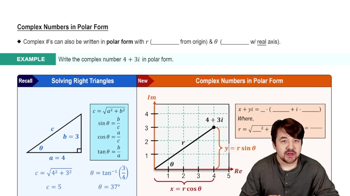
The polar form of a complex number expresses it in terms of its magnitude and angle, represented as z = r(cos θ + i sin θ), where r is the modulus and θ is the argument. This form is particularly useful for multiplication and division of complex numbers, as it simplifies calculations by allowing the use of trigonometric identities.
To divide two complex numbers in polar form, you divide their magnitudes and subtract their angles. Specifically, if z₁ = r₁(cos θ₁ + i sin θ₁) and z₂ = r₂(cos θ₂ + i sin θ₂), then z₁/z₂ = (r₁/r₂)(cos(θ₁ - θ₂) + i sin(θ₁ - θ₂). This method streamlines the process and helps maintain the polar representation.
The argument of a complex number is the angle formed with the positive x-axis in the complex plane, typically measured in degrees or radians. When expressing the argument, it is important to ensure it lies within a specified range, such as 0° to 360°, to maintain consistency and clarity in representation, especially when performing operations like division.