In Exercises 65–68, find all the complex roots. Write roots in polar form with θ in degrees. The complex cube roots of 27(cos 306° + i sin 306°)
Table of contents
- 0. Review of College Algebra4h 45m
- 1. Measuring Angles40m
- 2. Trigonometric Functions on Right Triangles2h 5m
- 3. Unit Circle1h 19m
- 4. Graphing Trigonometric Functions1h 19m
- 5. Inverse Trigonometric Functions and Basic Trigonometric Equations1h 41m
- 6. Trigonometric Identities and More Equations2h 34m
- 7. Non-Right Triangles1h 38m
- 8. Vectors2h 25m
- 9. Polar Equations2h 5m
- 10. Parametric Equations1h 6m
- 11. Graphing Complex Numbers1h 7m
11. Graphing Complex Numbers
Powers of Complex Numbers (DeMoivre's Theorem)
Problem 72
Textbook Question
In Exercises 69–76, find all the complex roots. Write roots in rectangular form. If necessary, round to the nearest tenth. The complex sixth roots of 64
Verified step by step guidance1
Express the given number 64 in its complex polar form. Since 64 is a positive real number, it can be written as \(64(\cos 0 + i \sin 0)\) or \(64 e^{i \cdot 0}\).
Identify the magnitude (modulus) and argument (angle) of the complex number. Here, the magnitude is \(r = 64\) and the argument is \(\theta = 0\) radians.
Use De Moivre's Theorem to find the sixth roots. The formula for the \(n\)th roots of a complex number is given by:
\(z_k = r^{1/n} \left( \cos \left( \frac{\theta + 2\pi k}{n} \right) + i \sin \left( \frac{\theta + 2\pi k}{n} \right) \right)\)
where \(k = 0, 1, 2, ..., n-1\).
Calculate the magnitude of each root as \(r^{1/6} = 64^{1/6}\). Then, for each \(k\) from 0 to 5, compute the argument \(\frac{0 + 2\pi k}{6} = \frac{2\pi k}{6} = \frac{\pi k}{3}\).
Write each root in rectangular form by evaluating the cosine and sine of each argument:
\(z_k = 64^{1/6} \left( \cos \left( \frac{\pi k}{3} \right) + i \sin \left( \frac{\pi k}{3} \right) \right)\)
Calculate these values for \(k = 0, 1, 2, 3, 4, 5\) and round to the nearest tenth if necessary.
Verified video answer for a similar problem:This video solution was recommended by our tutors as helpful for the problem above
Play a video:
0 Comments
Key Concepts
Here are the essential concepts you must grasp in order to answer the question correctly.
Complex Roots of Unity
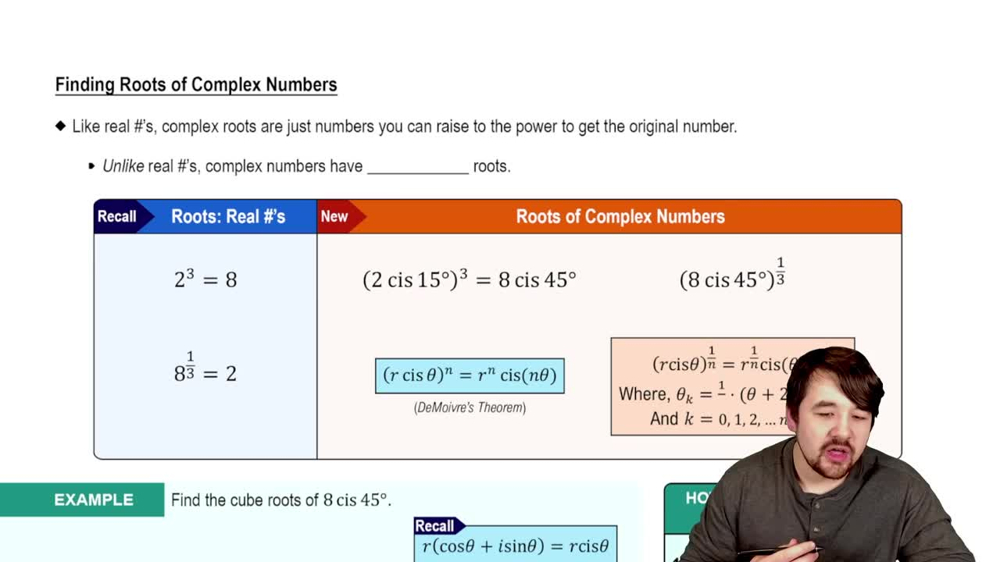
Complex roots of unity are solutions to the equation z^n = 1, evenly spaced on the unit circle in the complex plane. For any complex number, its nth roots are similarly spaced around a circle centered at the origin, with radius equal to the nth root of the number's magnitude.
Recommended video:
Complex Roots
Polar and Rectangular Forms of Complex Numbers
Complex numbers can be expressed in polar form as r(cos θ + i sin θ), where r is the magnitude and θ the argument. Converting to rectangular form involves calculating the real part r cos θ and the imaginary part r sin θ, which is essential for expressing roots in the requested format.
Recommended video:
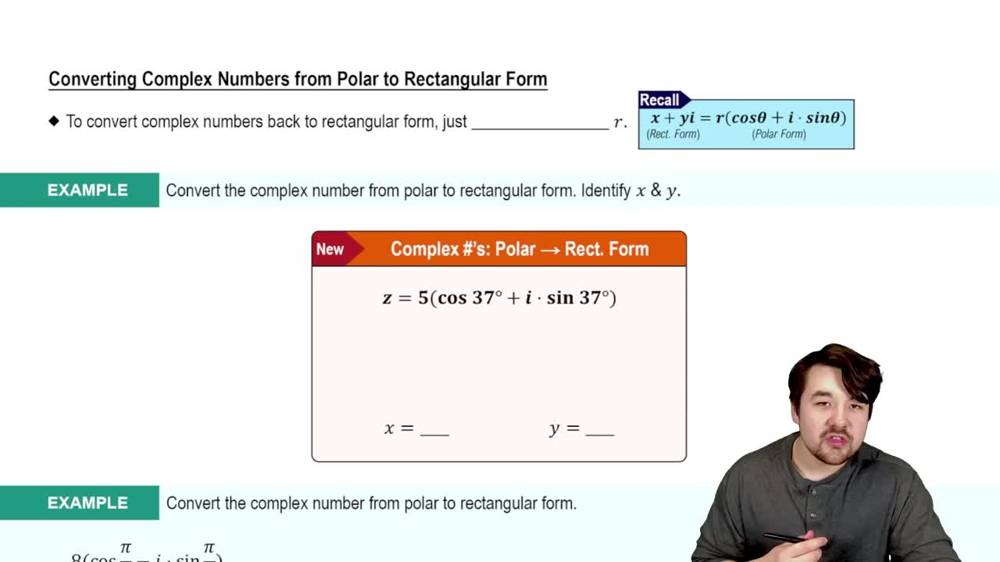
Converting Complex Numbers from Polar to Rectangular Form
De Moivre's Theorem
De Moivre's theorem states that (r(cos θ + i sin θ))^n = r^n (cos nθ + i sin nθ). It is used to find the nth roots of complex numbers by taking the nth root of the magnitude and dividing the argument by n, generating all roots by adding multiples of 2π/n to the argument.
Recommended video:
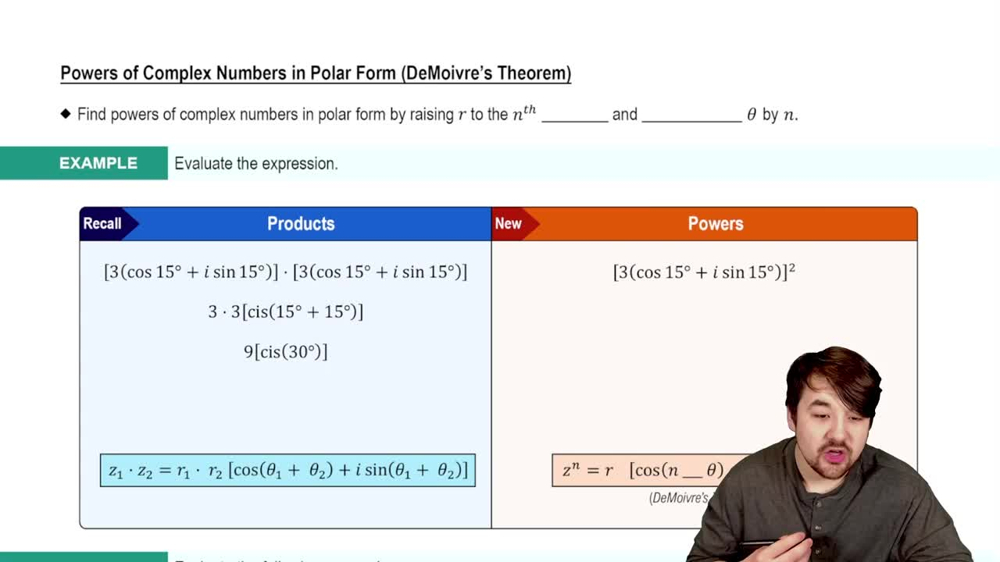
Powers Of Complex Numbers In Polar Form (DeMoivre's Theorem)
Related Videos
Related Practice
Textbook Question
412
views