Two forces act on a point in the plane. The angle between the two forces is given. Find the magnitude of the resultant force. forces of 250 and 450 newtons, forming an angle of 85°
Verified step by step guidance
1
Identify the magnitudes of the two forces and the angle between them. Here, the forces are 250 newtons and 450 newtons, and the angle between them is 85°.
Use the formula for the magnitude of the resultant force when two forces are acting at an angle: \( R = \sqrt{F_1^2 + F_2^2 + 2F_1F_2\cos(\theta)} \), where \( F_1 \) and \( F_2 \) are the magnitudes of the two forces, and \( \theta \) is the angle between them.
Substitute the given values into the formula: \( R = \sqrt{250^2 + 450^2 + 2 \times 250 \times 450 \times \cos(85°)} \).
Calculate the cosine of 85° using a scientific calculator or cosine table.
Evaluate the square root expression to find the magnitude of the resultant force.
Was this helpful?
Key Concepts
Here are the essential concepts you must grasp in order to answer the question correctly.
Resultant Force
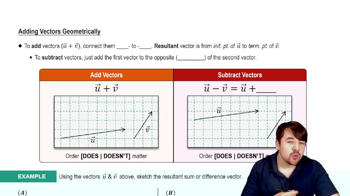
The resultant force is the single force that represents the combined effect of two or more forces acting on a point. It can be calculated using vector addition, which takes into account both the magnitudes and directions of the individual forces. In this case, the resultant force will be determined by the magnitudes of 250 N and 450 N and the angle between them.
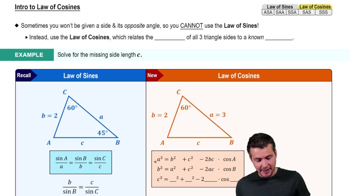
The Law of Cosines is a fundamental theorem in trigonometry that relates the lengths of the sides of a triangle to the cosine of one of its angles. It is particularly useful for finding the magnitude of the resultant force when two forces are not perpendicular. The formula is given by c² = a² + b² - 2ab * cos(θ), where c is the resultant force, a and b are the magnitudes of the two forces, and θ is the angle between them.
Trigonometric functions, such as sine, cosine, and tangent, are essential for analyzing relationships in triangles, especially in the context of forces. These functions help in determining the components of forces acting at angles. In this problem, the cosine function is particularly relevant for calculating the resultant force using the Law of Cosines, as it relates the angle between the forces to their magnitudes.