
Table of contents
- 0. Review of College Algebra4h 45m
- 1. Measuring Angles40m
- 2. Trigonometric Functions on Right Triangles2h 5m
- 3. Unit Circle1h 19m
- 4. Graphing Trigonometric Functions1h 19m
- 5. Inverse Trigonometric Functions and Basic Trigonometric Equations1h 41m
- 6. Trigonometric Identities and More Equations2h 34m
- 7. Non-Right Triangles1h 38m
- 8. Vectors2h 25m
- 9. Polar Equations2h 5m
- 10. Parametric Equations1h 6m
- 11. Graphing Complex Numbers1h 7m
1. Measuring Angles
Angles in Standard Position
Problem 70
Textbook Question
(Modeling) Grade Resistance Solve each problem. See Example 3. Find the grade resistance, to the nearest ten pounds, for a 2400-lb car traveling on a -2.4° downhill grade.
Verified step by step guidance1
Understand that grade resistance is the component of the car's weight acting along the slope due to gravity. It can be found using the formula: \(\text{Grade Resistance} = W \times \sin(\theta)\), where \(W\) is the weight of the car and \(\theta\) is the angle of the slope.
Identify the given values: the weight of the car \(W = 2400\) pounds, and the slope angle \(\theta = -2.4^\circ\). The negative sign indicates a downhill grade.
Calculate the sine of the angle \(\theta\). Since the angle is negative, \(\sin(-2.4^\circ) = -\sin(2.4^\circ)\), which means the grade resistance will be negative, representing a force aiding the motion downhill.
Multiply the weight \(W\) by \(\sin(\theta)\) to find the grade resistance: \(2400 \times \sin(-2.4^\circ)\).
Interpret the result: the magnitude gives the force in pounds, and the negative sign indicates the direction is downhill. Round the magnitude to the nearest ten pounds as requested.
Verified video answer for a similar problem:This video solution was recommended by our tutors as helpful for the problem above
Video duration:
3mPlay a video:
0 Comments
Key Concepts
Here are the essential concepts you must grasp in order to answer the question correctly.
Grade Resistance
Grade resistance is the force opposing the motion of a vehicle due to the slope of the road. It depends on the vehicle's weight and the angle of the incline or decline, calculated as the component of gravitational force parallel to the slope.
Trigonometric Functions and Angles
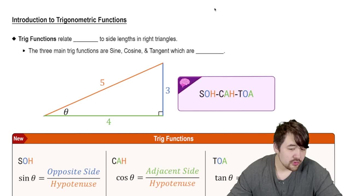
Understanding how to use trigonometric functions, especially sine, is essential to relate the angle of the slope to the forces involved. The sine of the grade angle gives the ratio of the vertical height change to the hypotenuse, which helps find the force component along the slope.
Recommended video:
Introduction to Trigonometric Functions
Force Calculation Using Weight and Angle
The grade resistance force is found by multiplying the vehicle's weight by the sine of the slope angle. For a downhill grade, this force acts in the direction of motion, and its magnitude is proportional to both the weight and the sine of the negative angle.
Recommended video:
How to Use a Calculator for Trig Functions
Related Videos
Related Practice
Textbook Question
Use a calculator to determine whether each statement is true or false. A true statement may lead to results that differ in the last decimal place due to rounding error. cos(30° + 20°) = cos 30° + cos 20°
461
views
