Graph each function. See Examples 6–8.h(x) = -(x + 1)³
Verified step by step guidance
1
Identify the basic function: The function given is a transformation of the basic cubic function \( f(x) = x^3 \).
Determine the transformations: The function \( h(x) = -(x + 1)^3 \) involves a horizontal shift, a reflection, and a vertical stretch/compression.
Horizontal shift: The term \((x + 1)\) indicates a shift to the left by 1 unit.
Reflection: The negative sign in front of \((x + 1)^3\) indicates a reflection across the x-axis.
Graph the function: Start by graphing the basic cubic function \( f(x) = x^3 \), apply the horizontal shift, and then reflect the graph across the x-axis.
Verified video answer for a similar problem:
This video solution was recommended by our tutors as helpful for the problem above
Video duration:
7m
Play a video:
0 Comments
Key Concepts
Here are the essential concepts you must grasp in order to answer the question correctly.
Graphing Polynomial Functions
Graphing polynomial functions involves plotting points based on the function's equation. The shape of the graph is determined by the degree and leading coefficient of the polynomial. For example, a cubic function like h(x) = -(x + 1)³ will have an 'S' shape, reflecting its turning points and end behavior.
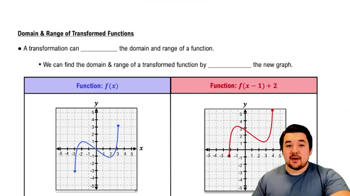
Transformation of functions refers to the changes made to the basic graph of a function through shifts, stretches, or reflections. In the case of h(x) = -(x + 1)³, the graph is shifted left by 1 unit due to the (x + 1) term and reflected across the x-axis because of the negative sign, altering its orientation.
Identifying key features of a graph includes determining the intercepts, turning points, and end behavior. For h(x) = -(x + 1)³, the y-intercept can be found by evaluating h(0), and the turning point occurs at the vertex of the cubic function. Understanding these features helps in accurately sketching the graph.