Recognize that the problem asks for the square root of 100, which means finding a number that, when multiplied by itself, equals 100.
Recall the definition of the square root: if \(x^2 = a\), then \(x = \sqrt{a}\) or \(x = -\sqrt{a}\), where \(a\) is a non-negative number.
Identify perfect squares near 100 to help find the square root. Since \$10^2 = 100$, 10 is a candidate.
Write the square root expression as \(\sqrt{100} = 10\) or \(-10\), because both \$10^2\( and \)(-10)^2$ equal 100.
Conclude that the principal (non-negative) square root of 100 is 10, which is typically the value referred to by \(\sqrt{100}\).
Verified video answer for a similar problem:
This video solution was recommended by our tutors as helpful for the problem above
Video duration:
57s
Play a video:
0 Comments
Key Concepts
Here are the essential concepts you must grasp in order to answer the question correctly.
Square Root Definition
The square root of a number is a value that, when multiplied by itself, gives the original number. For example, the square root of 100 is 10 because 10 × 10 = 100. It is denoted by the radical symbol (√).
Perfect squares are numbers that are squares of integers, such as 1, 4, 9, 16, and 100. Recognizing perfect squares helps quickly find their square roots without a calculator, as their roots are whole numbers.
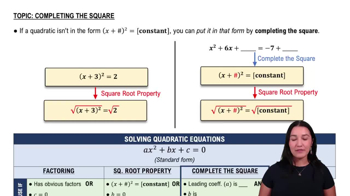
Solving Quadratic Equations by Completing the Square
Principal Square Root
The principal square root refers to the non-negative root of a number. Although both positive and negative values squared give the original number, the square root symbol (√) typically represents the positive root only.

 0:57 minutes
 Verified step by step guidance
 2:20
2:20