
Textbook Question
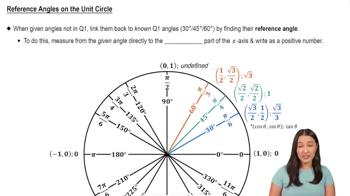
In Exercises 35–60, find the reference angle for each angle. -13𝜋/3
629
views

 Verified step by step guidance
 5:31
5:31
 5:04
5:04 3:47
3:47In Exercises 35–60, find the reference angle for each angle. -13𝜋/3
In Exercises 57–70, find a positive angle less than or that is coterminal with the given angle. -760°
In Exercises 63–68, find the exact value of each expression. Do not use a calculator. 1 + sin² 40° + sin² 50°
In Exercises 63–68, find the exact value of each expression. Do not use a calculator. tan(𝜋/3)/2 - 1/sec(𝜋/6)
In Exercises 41–56, use the circle shown in the rectangular coordinate system to draw each angle in standard position. State the quadrant in which the angle lies. When an angle's measure is given in radians, work the exercise without converting to degrees.
120°
In Exercises 57–70, find a positive angle less than or that is coterminal with the given angle. 395°